Archive

Monthly Archives: March 2012

(Photos by Jake)

Soon after I met Brad thirty-six and a half years ago, I cooked him osso buco for his birthday and he remarked,”This is the best thing I’ve ever eaten.” So I’ve continued to make it for him every birthday since, and he still reports that there is no better dish in the world. Then, when I had Fête Accomplie, my gourmet carry-out and catering business in Washington D.C. in the 80’s, a woman in the line of 30 customers declared loudly, “I’m Italian and I’ve never had better osso buco,” to which the other customers said, “What’s osso buco? I want it!”  From then on there was a constant demand. I do think it’s a wonderful dish and that simple cooking is best: No onion, no carrots, no celery in the sauce. Just the pure flavor of tomatoes and white wine and the incredible essences that pour out of the veal and the marrow. You must have the right cut of veal shank: Not those 3″ high solid bones with little marrow and less meat, but slices about 1 to1-1/2 inches thick with large marrow-filled bones and plenty of tender pale meat that falls off the bone and becomes slightly gelatinous when cooked. Osso buco means hollow bone and within the hollow bone is marrow and without it the purpose and perfection of the dish is sadly reduced. So, If the idea of eating this succulent morsel turns you off, then osso buco is probably not for you.

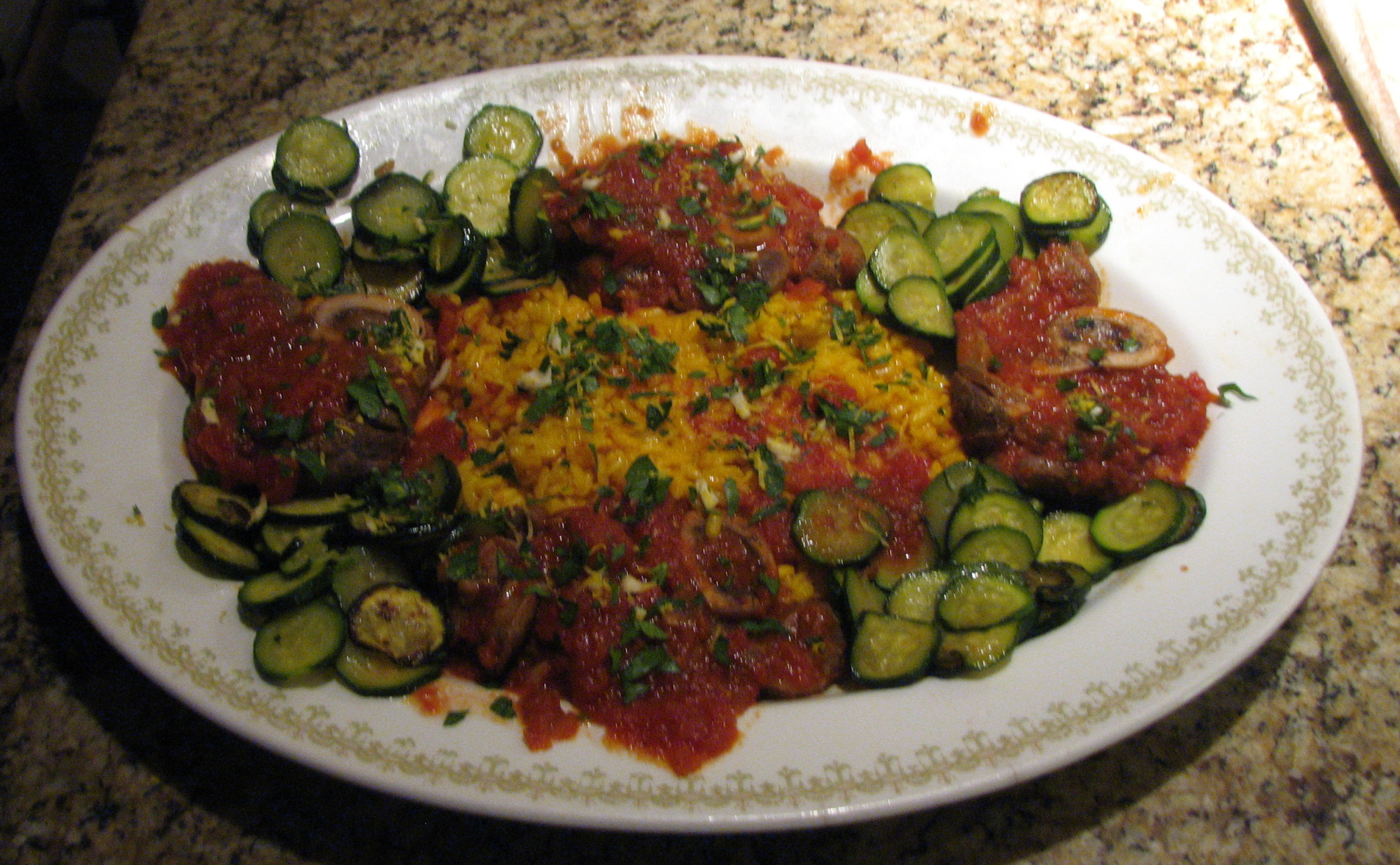
I like to serve it with the traditional risotto Milanese and gremolata, a chopped up mixture of lemon, garlic and parsley.

Steamed or sauteed zucchini is a nice accompaniment. It’s certainly a dish worthy of a special occasion.
Osso Buco

Serves 2-3 

Ingredients:

For the veal:

4 1 -1/2 inch meaty slices of veal shank

1 tablespoon butter

1/2 cup dry white wine

1-14 oz. can of the best tomatoes you can find

1 clove garlic, salt and pepper

For the risotto:

1/2 small onion, chopped

1 tablespoon butter

1-1/2 cups chicken stock

a pinch of saffron

3/4 cup arborio rice

For the gremolata:

2 tablespoons chopped parsley

1 large garlic clove, chopped fine

Grated rind of 1 lemon

3-4 small zucchini (optional)

Heat the butter in a sturdy pan over fairly high heat and brown the veal on each side for 2 minutes.  Pour over the wine and let it bubble and reduce by half.  Chop the tomatoes finely – I pulse them a few times in the food processor – and add them to the pan.  You may not need the full can, they should barely cover the veal.  Add the chopped clove of garlic and salt and pepper.  When it comes to the boil, turn down the heat, cover the pan, and let the veal simmer gently for 40 minutes.  Carefully turn the slices over, making sure you keep the veal and its marrow intact, cover the pan again, and continue to simmer.   Check after 20 minutes. The meat should show little resistance when pierced with a fork and the sauce should be thick – it may need another ten minutes or so with the lid off to further reduce the sauce.  The meat won’t mind.

For the risotto, cook the onion in the butter until softened, about five minutes.  Add the rice to the pan and stir it around for a good minute or two to make sure the rice is impregnated with the butter. Meantime warm the stock, add the saffron to it with a half-teaspoon of salt (if the stock isn’t salted) and add it to the rice, stirring.  As soon as it comes to the boil, cover the pan tightly, turn it down to the lowest possible heat, and cook for exactly 17 minutes.  Fluff it with a fork – it should be perfectly cooked but can rest, covered, for a few extra minutes.

For the gremolata, combine the parsley, garlic and lemon rind.

For the optional zucchini, cut it into either rounds or batons and steam it until just tender.  Or, if you prefer, you can saute it in a little butter.

Assemble the dish:  Mound the rice in the center of a large oval platter.  Surround it with the veal, placing the zucchini in between.  Spoon over the sauce, sprinkle with the gremolata and be ready to have one of the best things you’ve ever eaten.
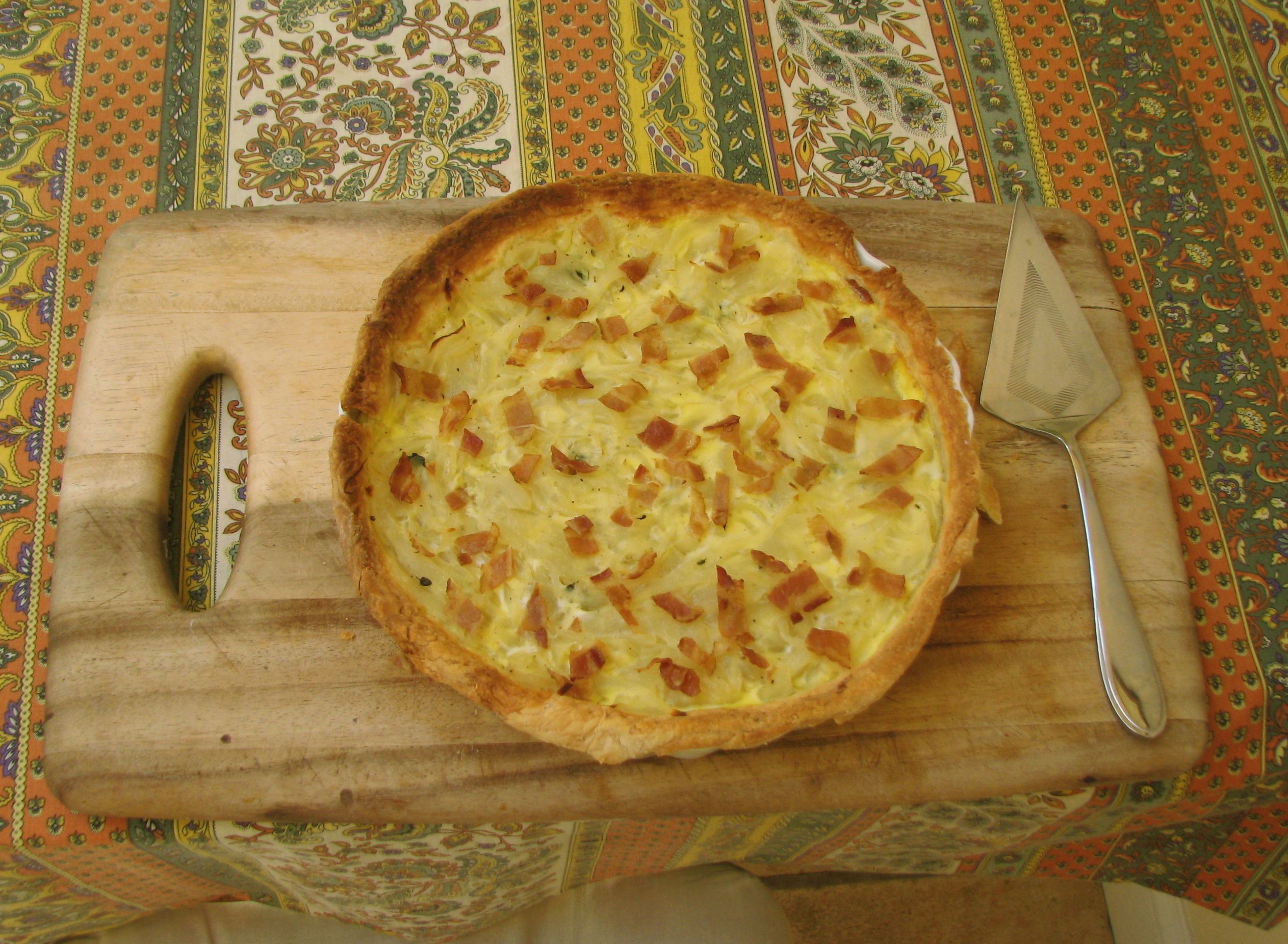
Alsatian Onion Tart

To tell you the truth, this is really a type of quiche, but because quiches developed a bad rap back when they were so overdone in the 80’s, we’re calling it a tart to avoid immediate rejection. Quiches have some excellent qualities–easy to make, relatively healthy, they can be eaten hot or at room temperature, taken on picnics, served at cocktail parties, and of course with a salad they make an excellent lunch or light supper. So bring back the quiche!  From the ubiquitous Quiche Lorraine to those made with spinach and mushrooms or ham and cheese, there’s a quiche to suit everyone’s taste.

My very favorite is the rich yet earthy onion tart. Its origins are in the Alsace region of France where it is often made without eggs or with the addition of cheese instead of bacon. I like to pack a pie shell to the brim with long-cooked, deliciously sweet onions, cover it with a mixture of eggs and cream and top it with a shower of crisp bacon. I start to feel hungry just thinking about it.

Serves 4-6

Ingredients:

1  9″ tart shell 

3-4 large onions (about 5 cups), thinly sliced and separated

2 tablespoons vegetable oil

1 tablespoon fresh thyme

4 slices bacon

3 large eggs

1 cup half and half (cream)

1 pinch nutmeg, salt and pepper


Preheat the oven to 350 degrees.  Line the tart shell with foil and fill with pie weights or dried beans.  Bake for 15 minutes until the bottom is cooked and the pastry shell is lightly browned around the edges.  Remove foil and weights and cool the baked shell.

Meantime, cook the onions:  Heat the oil in a large skillet, add the onions, the thyme, and a half teaspoon of salt. Cook over low heat, stirring, for a couple of minutes then cover the skillet with a tight-fitting lid and continue to cook for 20-25 minutes, stirring from time to time, until the onions are soft and beginning to caramelize.  If there is liquid remaining, drain them in a colander, reserving the wonderful onion juice for another use.

Cook the bacon strips in a non-stick skillet until barely crisp.  Drain on paper towels and cut into small pieces.

Whisk the eggs and cream, adding a grating (or pinch) of nutmeg, plus salt and pepper.  

When the onions are somewhat cooled and drained, distribute them evenly in the tart shell, pour over the cream mixture, and dot with the bacon pieces.

Bake in a 350-degree oven until the filling is just set and the top is golden.


Conchiglie with Anchovies, Garlic, and Chard (or Broccoli Rabe or Cavolo Nero or Cauliflower)

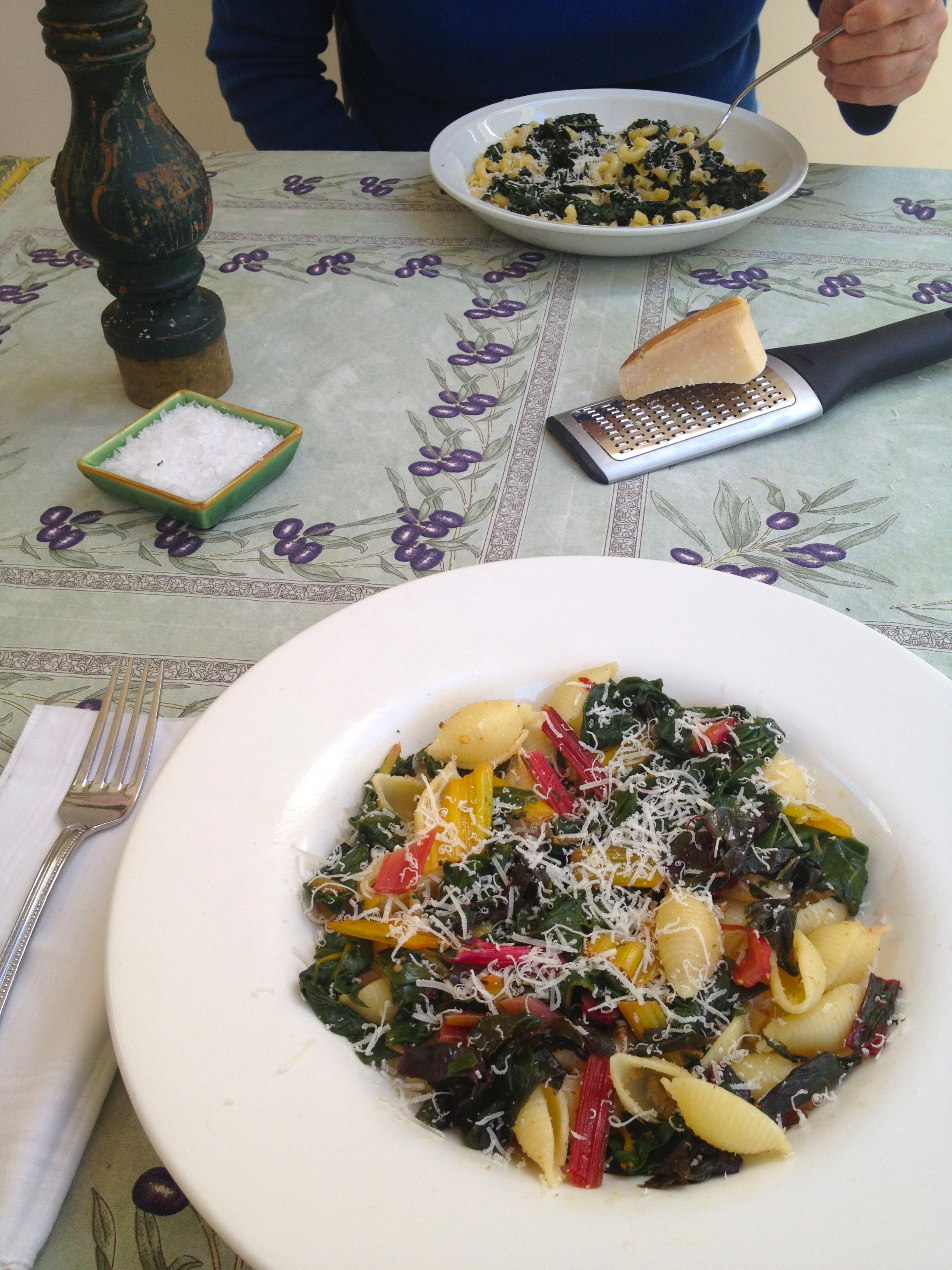
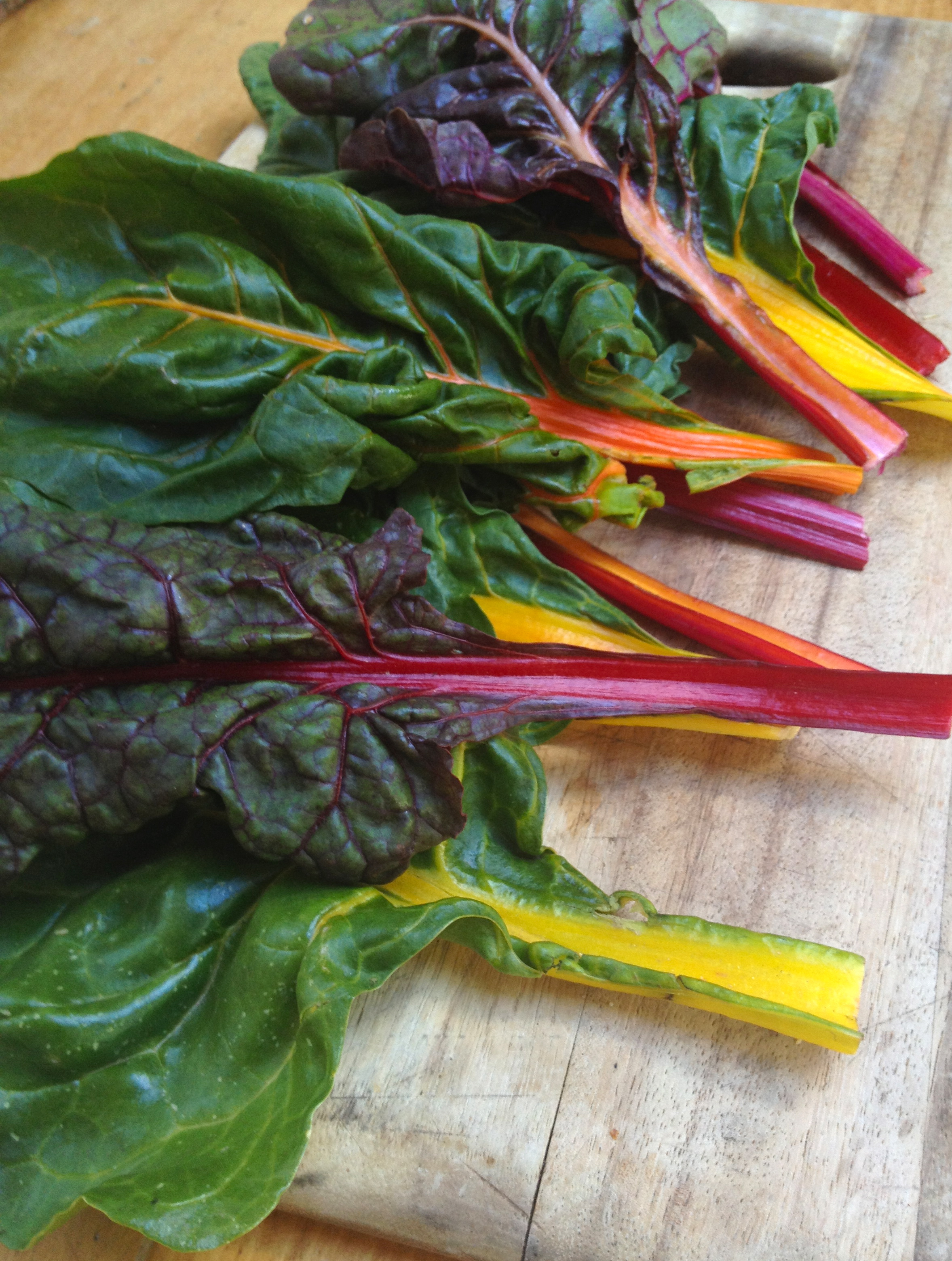
This is easily our favorite go-to pasta dish on those nights when the question of “What shall we have for dinner?” raises its head and we don’t feel like fussing. It’s comfort food–hearty enough for a wintry night, and also a cinch to make.  A saute of olive oil, garlic and hot pepper flakes to which you add a single vegetable. What could be simpler? Because we always have the basic ingredients on hand, it’s just a matter of acquiring a bunch of chard (or broccoli rabe or cavolo nero or a cauliflower) to complete the sauce – not too difficult to manage. If you’re not fond of anchovies you could leave them out, but I guarantee you won’t even notice their hairy consistency or distinctive flavor in the finished sauce, and it certainly gives a lift to the flavor. If you’re using chard, a whole rainbow of colors is now available. Having just bought a bunch of beautiful young red, yellow and orange chard, I decided it would be criminal to throw out the beautiful stems so I cut them into 1″ pieces and cooked them briefly before adding the leaves. Success! The extra bite they give is just perfect.  I like to use a pasta such as conchiglie, fusilli, penne, or perciatelli –  sturdy enough for the robust sauce.

Serves 2

Ingredients:

Two Tbsp. olive oil

1/2 cup chopped parsley (optional)

1/2 teaspoon hot pepper flakes (or more, if you like it hotter)

6 canned anchovy filets 

A large clove garlic, finely chopped

A bunch of large chard, stems and tough ribs removed   or

A bunch of young rainbow chard, stems separated and cut into 1″ pieces

Parmesan

Heat the oil over low heat in a sturdy pot for a minute of two.  Add the optional parsley, pepper flakes and anchovies and cook until the anchovies have melted, about 5 minutes.  Add the garlic and continue to cook a few minutes longer until the flavors have melded.  I add the garlic last because burnt garlic can ruin any dish and burning can happen easily if you start with garlic in too-hot oil. In the meantime blanch the chard in boiling salted water for 3-4 minutes. (If you are using young rainbow chard, cook the stems for 4 minutes before adding the leaves and continuing to cook for a further 4 minutes.)   Drain well and chop it coarsely.  Add to the oil/garlic mixture and let it continue to cook over low heat for a minute or two.

In  the meantime cook the pasta al dente according to the package directions and  add it, drained, to the chard mixture. A little of the cooking water will loosen the mixture. Stir it around, adding a bit of extra olive oil if desired. Check for salt and serve with lots of freshly grated parmesan.

Variations: Use broccoli rabe instead. Blanch it in the same way as the chard for 3-4 minutes, chop into about 1 inch pieces and proceed as above.

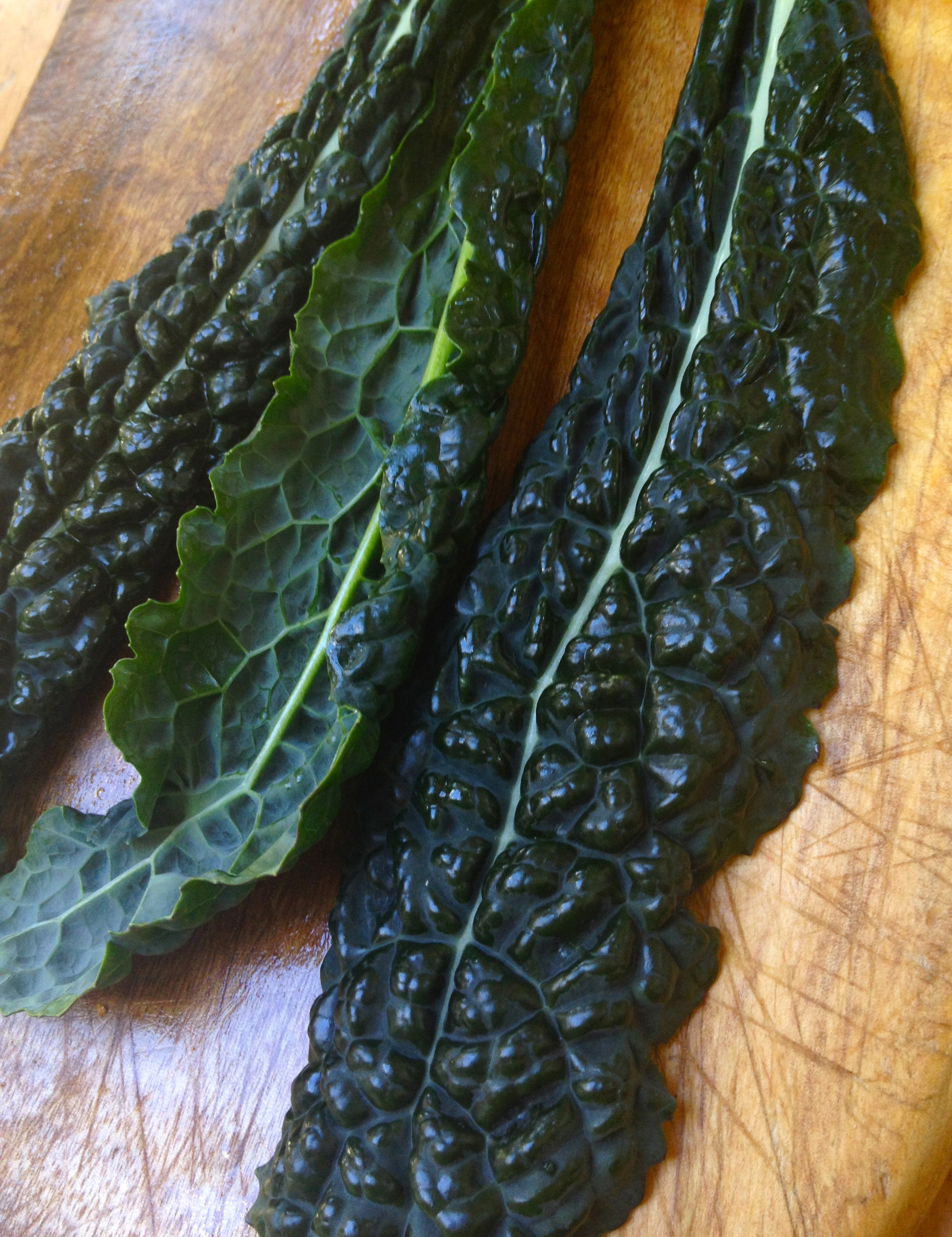
If you can find cavolo nero (also called Tuscan kale, dinosaur kale, and lacinato kale–see picture below), you’re in for a real treat. It’s very common in soups and sauces in Tuscany and is becoming increasingly popular in the U.S.  Look for it at your farmer’s market or local produce store. Tear out the tough central stem and discard it, as with the chard. You will need to cook it for about 10 minutes before draining it, chopping it coarsely and adding it to the oil/garlic mixture.

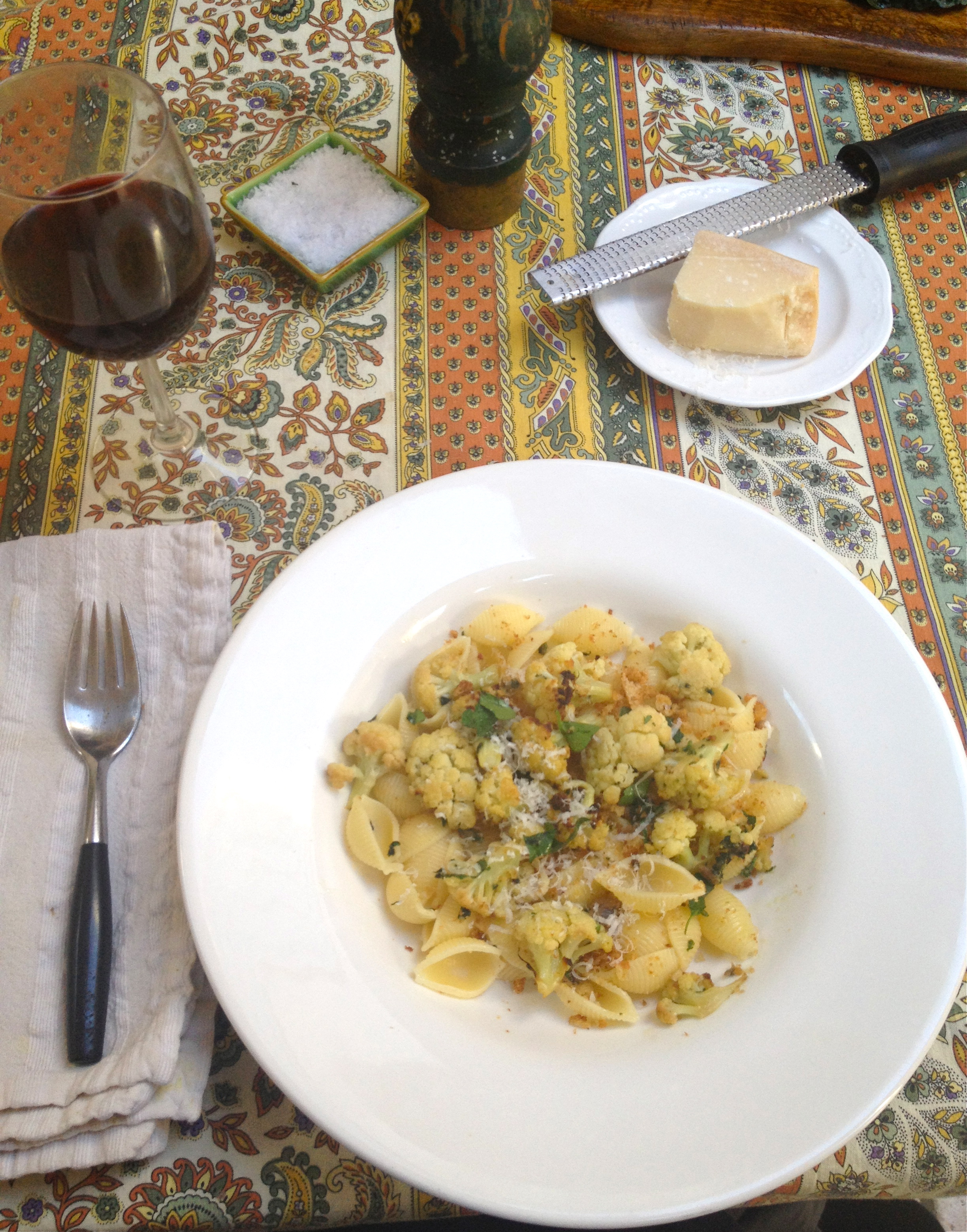
If you’re using cauliflower, a nice addition is a tablespoon or two of toasted breadcrumbs, preferably homemade, as well as a tablespoon of parsley. Cut the cauliflower into flowerets, discarding the core, and toss them in a tablespoon of olive oil. Roast them in a 350-degree over for about 20 minutes until a little brown and crisp around the edges and l still a little bitey (or you can steam or boil them until barely cooked.) Mix into the oil/garlic base, add the pasta and serve sprinkled with the  toasted breadcrumbs, parsley and parmesan.

I know I’ve complicated things by suggesting four different vegetables, but each is so delicious that I’m not going to apologize.