Archive

Monthly Archives: June 2012

It’s June 21st(ish) and summer has officially arrived. And just as well, because after a somewhat cold and windy spring, it has in the past few days become unpleasantly hot.  The cicadas are all too aware of the change of season: they took up their summer posts today and have begun their high-pitched chant which loses its charm quite quickly, particularly as they position themselves very close to the pool and the house. Still, it’s reassuring to know that they’ve survived yet another year.

Summer makes us think first of all of tomatoes, which because of the cold spring, are just beginning to be worth eating.

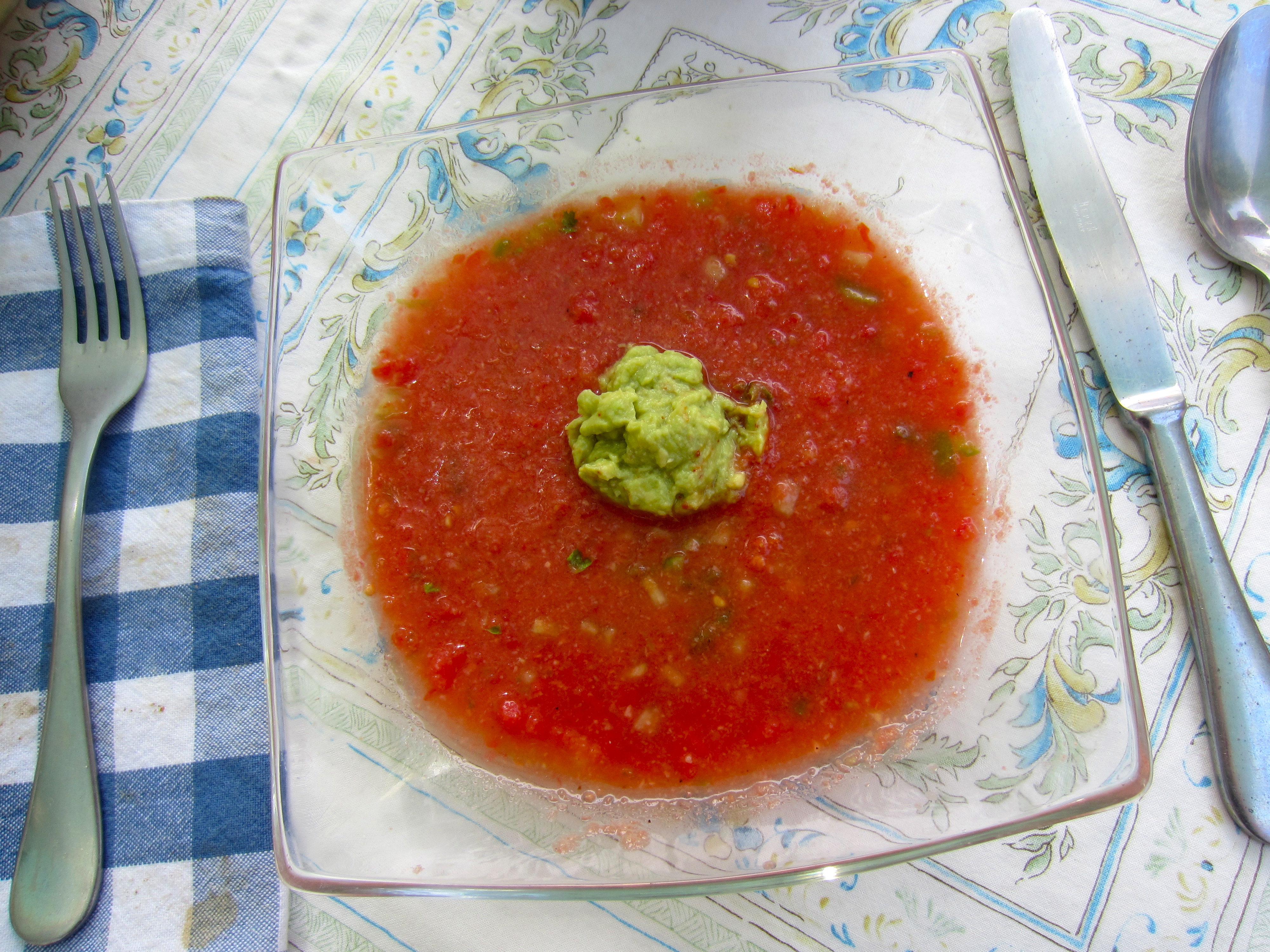
When they’re at their peak we eat tomatoes virtually every day in one form or another – salads, stuffed, in sauces, and of course, as gazpacho.  I think we could probably go a whole summer on a diet of gazpacho. In Spain now you can find it made with watermelon and strawberries and beets and cherries and all sorts of other exotic ingredients but none of them really beats the original. Our gazpacho tends to be less liquid than most you’ll come across in Spain because we like to load it up with garnishes and don’t like to dilute the tomatoes with too much water. Suit yourself. If you like it thinner, add more water. I’m not keen on tomato juice as I think it subverts the pure taste of good tomatoes. I do think it’s important to use sherry vinegar and a Spanish olive oil, if you can find it.

I’m also giving our recipe for salmorejo, which is from Córdoba. It’s a close cousin of gazpacho, which originated in Seville. It’s made without onion or cucumber.  Some days we think we like it better.
Gazpacho

Serves 4

Ingredients:

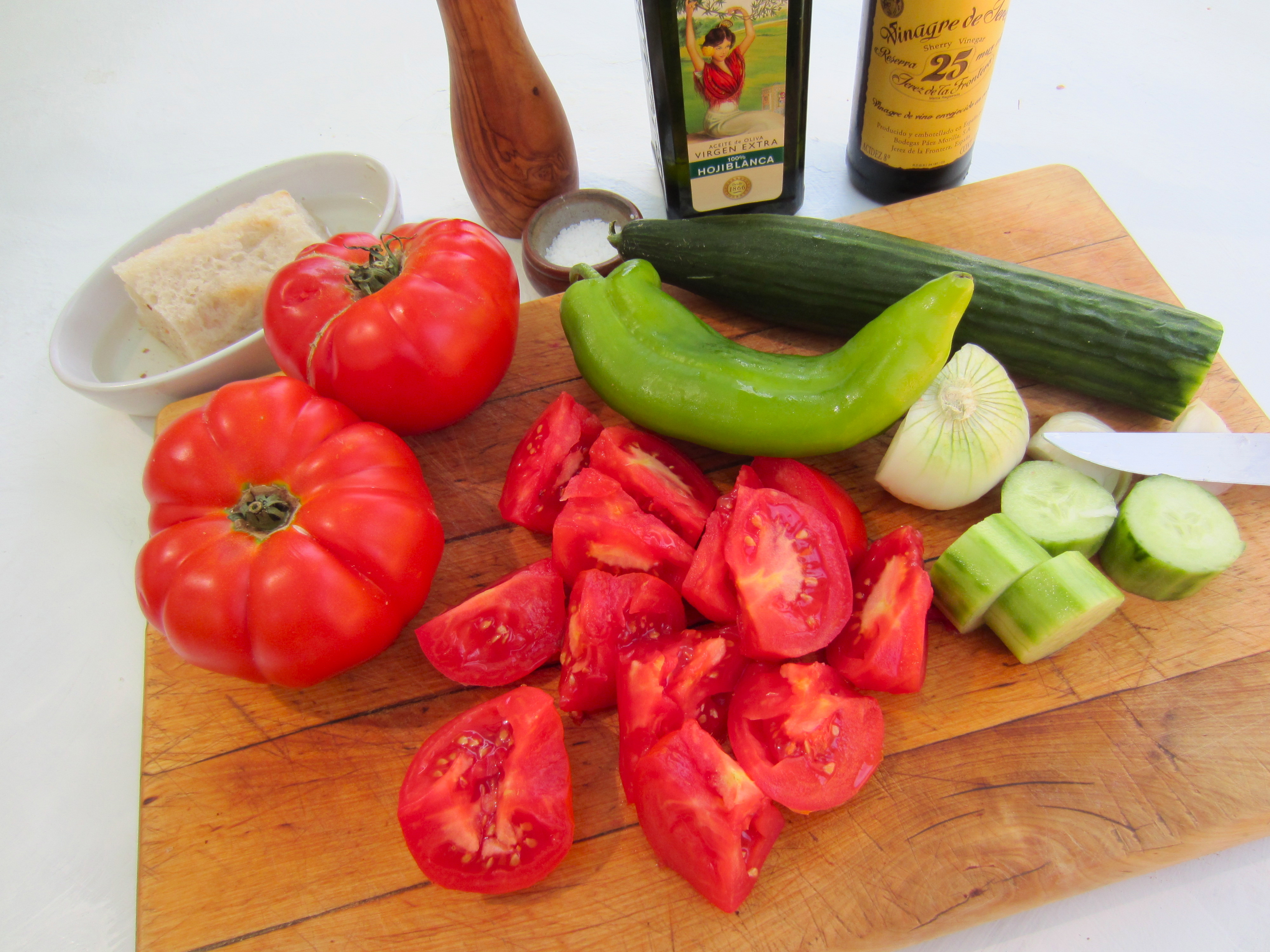
3″ piece day-old baguette, crust removed

2 – 2-1/2 lbs. the ripest, juciest tomatoes you can find

1/3 English cucumber, peeled or 1/2 regular cucumber, peeled and seeded

1/2 light green, thin skinned pepper or 1/3 regular green pepper

2 tablespoons red onion or any mild onion such as Vidalia

1 large clove garlic

Salt and pepper

Pinch piment d’Espelette (optional)

2+ tablespoons olive oil (preferably Spanish hojiblanca)

1 tablespoon aged sherry vinegar

For the garnish:

2 tablespoons finely chopped cucumber

2 tablespoons finely chopped green pepper

A few chopped basil leaves (optional)

Soak the bread in water for 5-10 minutes then lightly squeeze out the water.  Core the tomatoes and cut them into large chunks.  Cut the cucumber, pepper and onion into smallish pieces.  Working in batches, process a mixture of each of the vegetables until smooth, saving a few pieces of tomato. Process the garlic in the food processor and then add the bread, oil, vinegar, the saved pieces of tomato, salt, pepper and optional piment d’Espelette and blend until you have a creamy dressing, adding up to a half cup of water.  Add this to the tomato mixture and check for taste.  You may want more salt and/or vinegar. 

Now if you want a really smooth gazpacho, run the whole thing through a blender – not essential, but definitely an improvement.  Chill the gazpacho for up to 2 hours. If I haven’t planned ahead, I put the gazpacho in the freezer for up to twenty minutes, stirring it once half-way. I like to fold in the cucumber and pepper garnishes (instead of serving them in a bowl) and top each serving with a splash of olive oil and a sprinking of chopped basil if I have it on hand. For variety, or for a festive occasion, I sometimes add a dollop of guacamole or a few cooked shrimp as a garnish!

Salmorejo

Use the ingredients listed for gazpacho, increasing the bread to a 4″ piece and eliminating the cucumber and onion.

Make it in exactly the same way but I do think it’s important to put the mixture through a blender at the end.  The traditional garnish is finely chopped hard-boiled egg white and chopped Serrano ham.  I’m not keen on the egg but do like to use Serrano ham or proscuitto.  Try both and see what you think. 
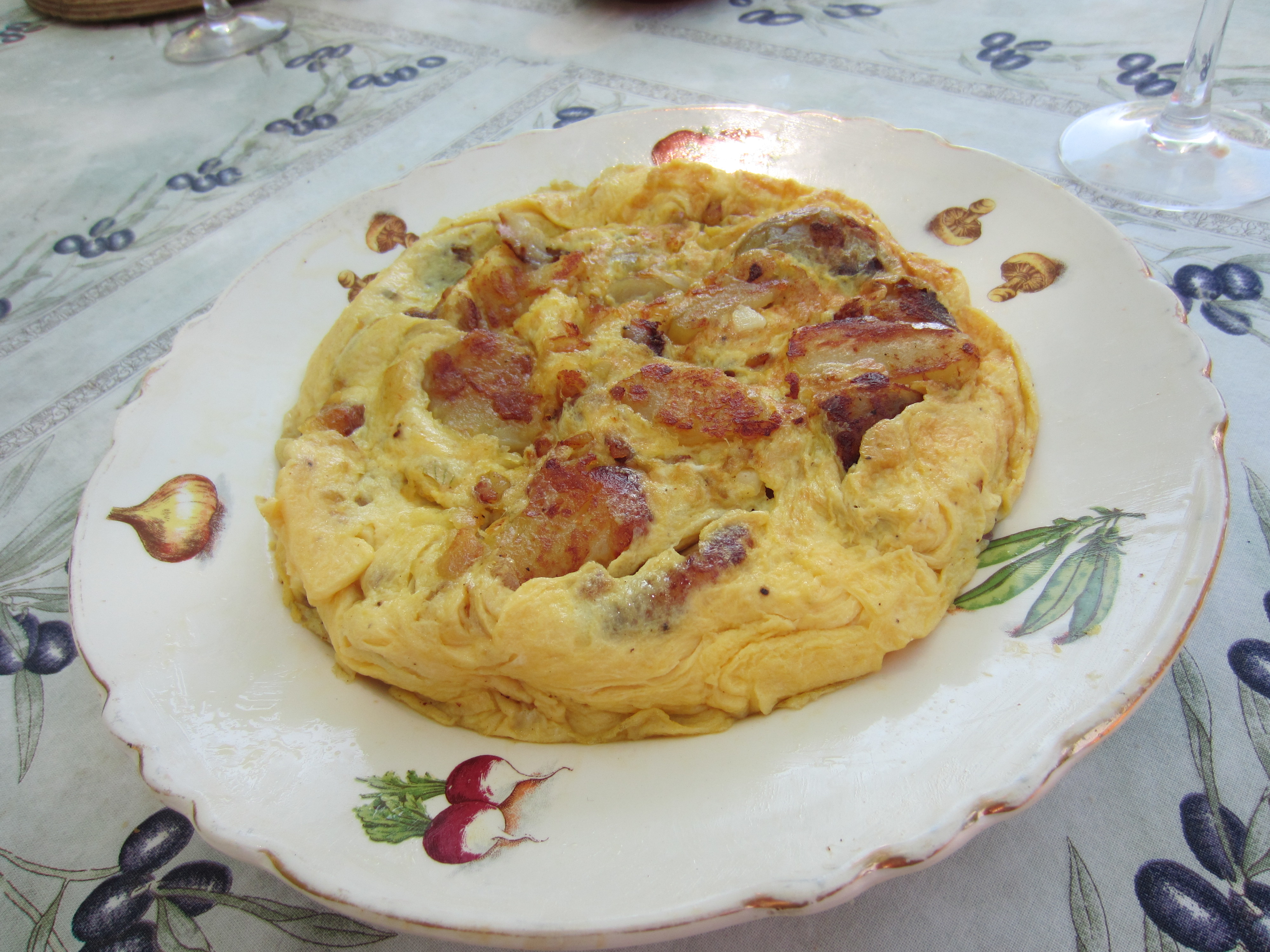
We spent the past week in the Basque country, mostly in Spain but a few nights in France as well.  It is really a beautiful part of the world and well worth a visit.  I thought that I would collect recipes while we were there for some of the wonderful tapas we had in the bars of San Sebastián – there called pintxos – and put them on my blog, but in retrospect this doesn’t seem like such a good idea: A lot of the ingredients we love best are not generally available (foie gras, jamon Ibérico, salt cod, fresh anchovies, albacore tuna, piquillo peppers, wild mushrooms) and then the skewers and canapes that sparkle on the bar counters are mostly a lot of trouble to make.  So I’m just going to give my version of the most universally popular tapa of all – tortilla de patata – and hope that you will be able to make it to San Sebastián sometime soon to experience the tapas for yourselves.

Eggs are much loved in Spain and the tortilla is the most loved of all egg dishes. And why not? You can have it for breakfast, lunch, or dinner, hot, warm or cold, take it on picnics, put in in a sandwich or serve it at your tapas party.

Not to mention it’s quite delicious.

Most Spaniards know how to cook a tortilla and most think that their version is the best.  You can fry the potatoes in a lot of oil with a little onion, mix it with the eggs, and then cook it fairly slowly.  Some don’t flip it but put it under the broiler to finish the cooking but I think this makes it tough. Some cook it for as long as 20 minutes, also a mistake.  Here is my version which I of course think is the best.

Tortilla Español

Serves 4

Ingredients:

4 medium potatoes, peeled (preferably Yukon Gold)

1 medium onion, sliced thin

1 clove garlic, chopped fine

4 tablespoons olive oil

6 eggs

salt and pepper

Boil the potatoes over medium heat until almost cooked, about 15 minutes.  In the meantime, fry the onion in one tablespoon olive oil in a 8″ non-stick skillet over gentle heat until well softened, 10-15 minutes.  Set aside.  When the potatoes are cool enough to handle, slice them into 1/4″ rounds. Heat 2 tablespoons oil in the same skillet and fry the potatoes until cooked through and browned around the edges, about 10 minutes.   Stir the cooked onions, the garlic, salt and pepper into the potatoes mashing them up a bit and being careful that the mixture doesn’t stick and burn.

Meantime, beat the eggs until well mixed, adding a little salt and pepper.  Turn up the heat to high, add a little more oil if necessary and when the pan and the potatoes are sizzling, add the eggs. Flatten the mixture with a spatula so that it covers the pan fairly evenly. The eggs will immediately begin to set around the edges.  Turn the heat to medium and with a spatula, start pulling the set eggs into the center, going round and round the pan so that the uncooked egg runs to the outside.  When all the egg is lightly set but still moist, run the spatula underneath the mixture to make sure it hasn’t stuck. This should take 2-3 minutes.

Now comes the tricky part:  You will need a rimless plate, slightly larger that the pan.  Place the plate over the skillet and quickly invert the tortilla onto the plate. (Practice will make this easier.)  Add the rest of the oil to the skillet and slide the tortilla back into the pan, uncooked side down, straightening it into a round shape.  If the pan is hot enough, it will only take a minute or two for the bottom to cook – you don’t want it to get rubbery and dry.  Invert it on to the cleaned-up plate, blotting it with paper towels if necessary. It should be beautifully round and lightly browned.

You can eat it immediately for brunch or supper with a tomato or green salad and some crusty bread.  Cut it into wedges like a cake. It’s also great warm or cold on a picnic.  And if you want to serve it as a tapa, cut it into squares and serve it with toothpicks.

Variations: While I think a  straight potato tortilla is the most authentically Spanish, feel free to add sauteed red peppers (or piquillos) or chorizo or ham or even veggies such as artichokes or asparagus for variety. 

Image
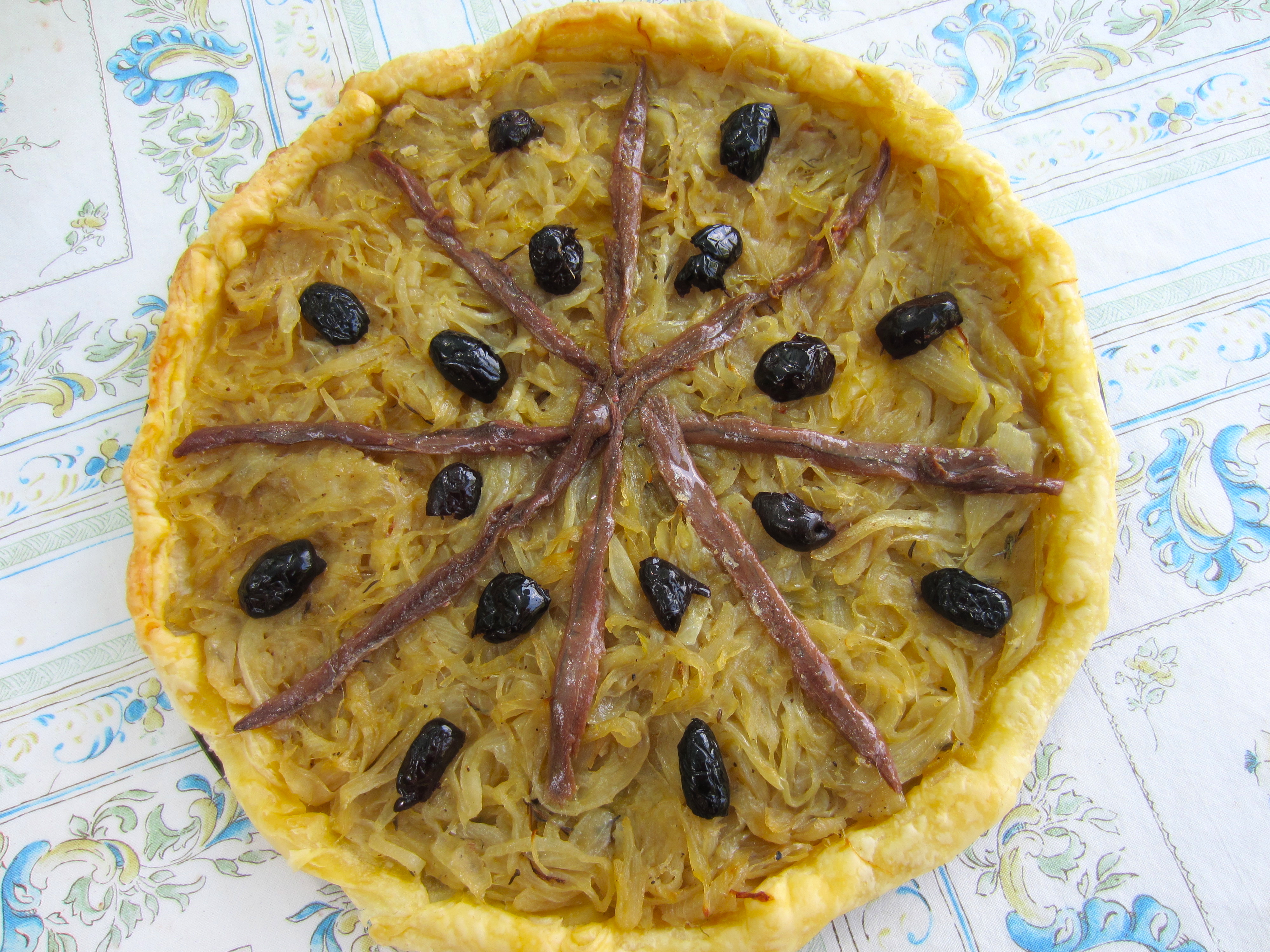
Pissaladière (pronounced pees-ah-lah-dee-air) is often called the Provençale pizza. But it’s really something else entirely. No tomato, no cheese – just lots of lightly caremelized onions, plus anchovies and olives. Very simple to make and delicious with a glass of rosé or a chilled white. I like to use puff pastry, but you can make it with pizza dough if you prefer. The secret is to cook the onions until they’re beautifully amber colored and sweet. Of course if you don’t like anchovies and/or olives, this recipe is not for you. Tant pis!

Pissaladiére

Serves 4

1 packet (frozen) puff pastry

2 tablespoons olive oil

2 lbs. (about 5 large) onions, thinly sliced

1 teaspoon chopped fresh thyme

salt, pepper

1 small can anchovies

16 Niçoise or other small French black olives

Thaw the pastry, if necessary.  You can make the pissaladière either round or oblong, depending the shape of your baking sheet or pizza pan.

Heat the oil in a large heavy skillet over low heat.  Add the onions – it will seem like a lot but they reduce considerably. 

Cover and cook unti they are very tender, stirring occasionally, about 30 minutes.  Uncover and saute until most of the liquid has evaporated and the onions are golden, about 10 minutes longer.  Stir in the thyme and season with salt andpepper.  Remember that the anchovies and olives are salty. Drain the onions if there is still more than a teaspoon or two of liquid. Let cool.

Preheat the oven to 400 degrees.  Lightly oil your baking sheet or pan and roll out the dough on a floured surface to fit it.

Crimp the edges of the dough to form a border.  Spread the onions evenly over the dough and bake at a fairly low poisiton in the oven so that the pastry cooks through on the bottom, about 25 minutes.  

Decorate the dish. Some do this earlier but cooked anchovies lose their form and somehow begin to taste a little musty. In a round pan, place the anchovies as spokes in a wheel and put a couple of pitted black olives between the spokes. If your pan is rectangular, make a grid with the anchovies and place an olive in each square. To the good people of Nice either form can make the mouth water.

It’s best to eat a pissaladière as soon as it’s cool enough to handle but it can also be gently reheated. Brad says that even pissaladière at room temperature is way better than no pissaladière at all.

Nice is our favorite city in France, possibly the world.  With its spectacular placement between the Alps and the Mediterranean, historic old town, vibrant street market and upscale shops, it’s always a pleasure to visit.

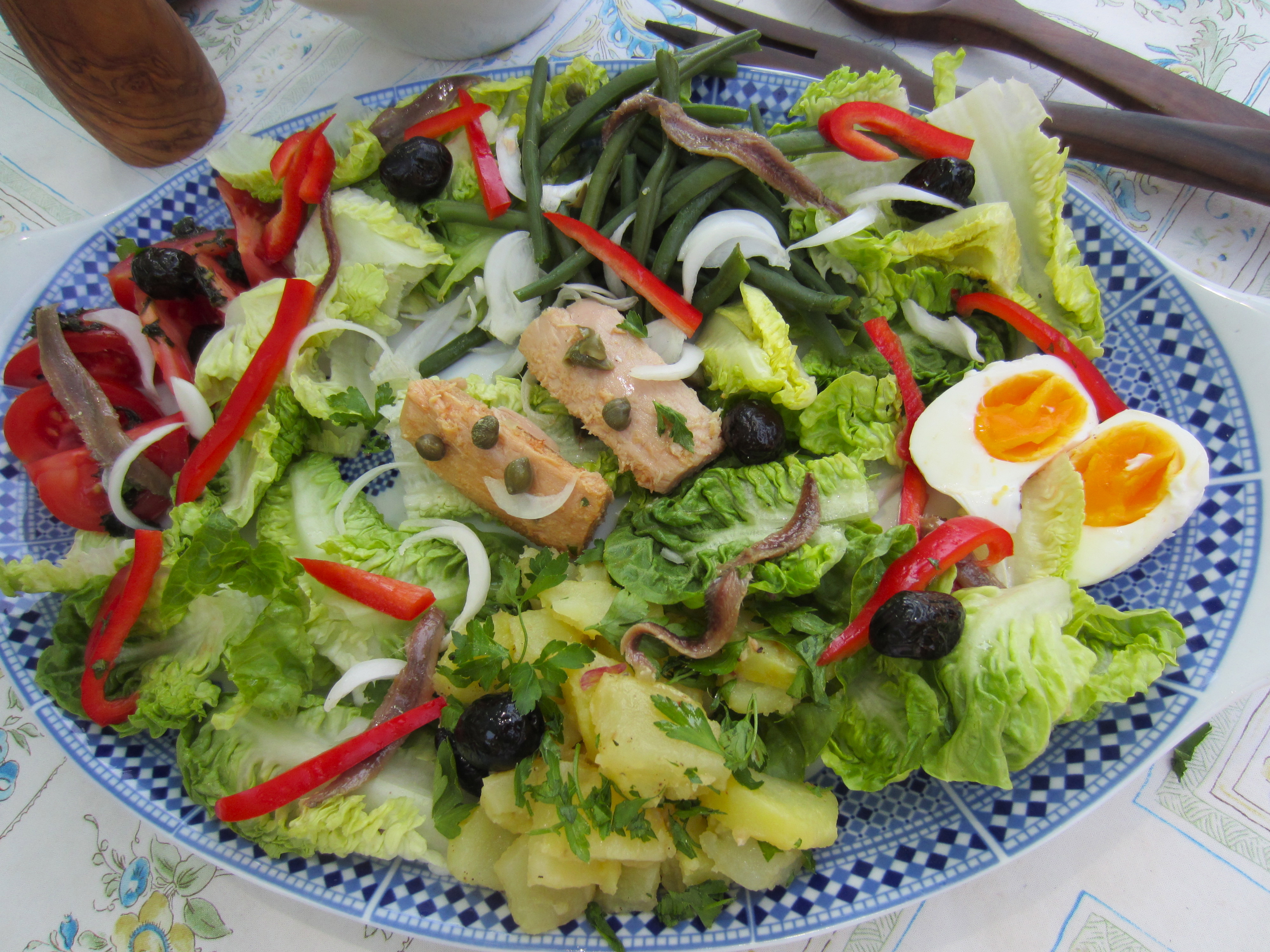
At our favorite restaurant in the old town, Bistro d’Antoine, I recently ordered the salade Niçoise at the urging of our waitress who assured me that it was both “differente et delicieuse”. On one side was a pile of dressed roquette (arugula). In the middle were a couple of house-cured anchovies, a small piece of grilled fresh tuna, and a beautiful barely-cooked half egg. On the other side was a pile of finely chopped and dressed veggies – fava beans, fresh peas, baby artichokes, fennel, zucchini, radish, red and green peppers, tomatoes, basil and olives -that Antoine the owner painstakingly ennumerated, none of them cooked. And the fresh anchovies and tuna? “I never use anything canned”, he explained.

It was indeed so delicious that we hastened to make it a few days later, including curing our own fresh anchovies, but for us it was a “new” salad, not the Niçoise we’ve known and been making for centuries.

There are basically three kinds of Salade Niçoise – the original (stoutly defended by locals as the only authentic one) which has no COOKED vegetables of any sort; the one served almost universally which includes COOKED potatoes and green beans; and one that has emerged in recent years which is topped with a piece of grilled fresh tuna instead of the more traditional canned.  Our preferred version is the second one. The good thing about it is that it’s suitable for so many occasions – lunch, a simple summer dinner for four or a larger gathering, and kids love it.

I must admit that I’m fairly rigid about what goes into my salade Niçoise. The essentials: lettuce, tomatoes, hard-boiled eggs, black olives, cooked green beans and potatoes, canned tuna and anchovies; optionals: radish, sweet white onion, red pepper slices, capers and fresh herbs.

SALADE NIÇOISE

Serves 4 

 Ingredients:

 1/2 lb. green beans (the freshest and youngest you can find)

1 lb. new potatoes, either red or white skinned

2 eggs

2 or 3 ripe tomatoes (or cherry tomatoes), quartered or halved lettuce

basil leaves (optional)

a dozen black olives

1 can or bottle of the best tuna (preferably Spanish or Italian) in olive oil

1 can flat anchovies (or packed in salt or home cured)

For the vinaigrette:

1 clove garlic

1/2 teaspoon salt

1 tablespoon vinegar 

1/2 cup olive oil

Pepper

Vinaigrette:

Crush the garlic with the salt in a pestle and mortar.  Add the vinegar, then the olive oil and a good grinding of pepper.

Mix well.

Top and tail the beans and cook them to the degree of “doneness”  that you like.  Immediaty rinse them in cold water to stop the cooking and drain well. Mix with a teaspoon of the vinaigrette.

Cook the potatoes (15-25 minutes, depending on size). If they’re small, I like to leave the skins on.  Otherwise peel. When cool enough to can handle, cut into bite-size pieces and dress with a good tablespoon of the vinaigrette.  You can add herbs if you like – tarragon, parsley, and chives are all a welcome addition.

Put the eggs in a pan of cold water.  Bring just to the boil, cover, turn off the heat and leave for 12 minutes. Rinse in cold water, peel and cut in half lengthwise.

Now comes the fun part – assembling the dish.  You will need a fairly large platter.  I like to line it with beautifully fresh lettuce leaves, torn into manageable pieces.  Then I put the tuna in the center and surround it with piles of potatoes, green beans, sliced tomatoes, and the halved eggs.  Let your artistic juices flow.  Decorate with the olives, anchovies, and, if you choose, any of the following: basil leaves,  thin slices of red pepper, radishes, sweet onion and capers.  Dressing the dish is a bit tricky.  You already have some vinaigrette on the beans and potatoes but now you have to distribute the rest of it, particularly on the tomatoes and lettuce.  Sometimes it’s easier to just spoon it onto individual plates after serving.  But do serve it at once – with some crusty French bread and a glass or two of Provençal rosé.  Bon appetit!

Variations:  To make Bistro Antoine’s salade Nicoise, chop a selection of the vegetables mentioned into a dice and dress with the vinaigrette in my recipe, saving some for the roquette.  Serve with tuna, either cooked or canned, anchovies, and hard boiled eggs.

For version three, grill a 12-oz. piece of tuna on the barbeque or a grill pan and place it in the center of “my” salad instead of the canned tuna.  Three oz. a person should be plenty.

One could long debate the authenticity of any single recipe.  My only guarantee is that, whatever recipe you follow, you and your fellow eaters are in for a treat.