Even though there’s a wide variety of salad greens available year round, it’s not always easy to come up with salad ideas in the winter that are robust enough to suit the season.  Here are three that I hope pique your interest.

As I was making both the lentil salad and the Moroccan orange salad, I was torn about what garnishes to add.  The lentil salad is delicious without beets and feta, particularly if you’re serving it with an entree like chicken or pork or salmon. It’s also good with a garnish of crisp bacon or rounds of sausage.  There are many versions of the orange salad – some sweet, some savory, all delicious.  With this in mind, I’ve decided that it’s time to be more flexible with my recipes.  From now on, look for a “Variations” section within select recipes that I feel can be made more than one way.
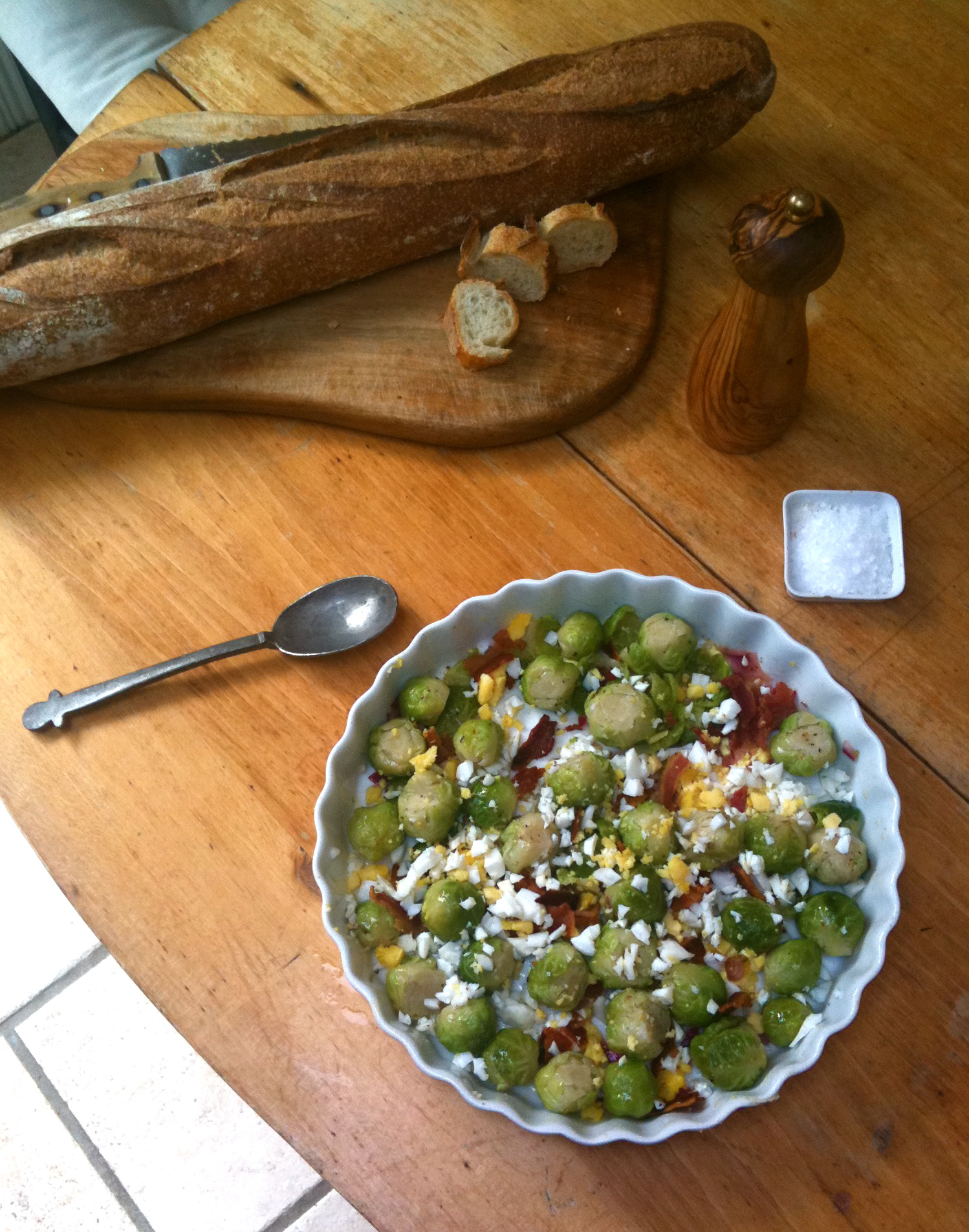
Roasted Brussels Sprouts with Egg and Bacon

This is not one for which I would offer alternative garnishes – adding chopped hard-boiled eggs and crisp bacon to the Brussels sprouts is just the ticket.  The only variation I would suggest is that if you’re too lazy to roast the sprouts, you can boil them.  You can also separate the leaves if you prefer but I like the crunchiness of the sprouts just cut in half.  Roasting them until they’re a bit blackened at the edges definitely enhances their flavor.

Serves 4

Ingredients:

1 lb. Brussels sprouts

2 hard boiled eggs

4 strips bacon

1 tablespoon olive oil

Salt, pepper

for the Vinaigrette:

1/2 teaspoon salt

1 tablespoon diced shallot (or other mild onion)

1 teaspoon Dijon mustard

2 teaspoons red wine vinegar

2 tablespoons olive oil

Preheat the oven to 375 degrees. Trim the ends of the sprouts and pull off any yellow outer leaves. Halve the sprouts and toss them with the oil, salt and pepper.  Put them in the oven on a baking sheet, cut side down, and roast 30-35 minutes until they pierce easily with a skewer and are crisp and brown round the edges. 

To make the vinaigrette: Crush the shallot with the salt.  Add the mustard, then the vinegar and oil. 

When the Brussels sprouts are cooked, toss them with the vinaigrette.

Meanwhiile cook the bacon strips until crisp and then dice.  Chop the egg yolks and whites separately.

Mix some of the chopped bacon and egg in with the sprouts and garnish with the rest.

French Lentil Salad with Beets and Feta

The best lentils for this are the green French lentils du Puy, now readily available at most grocery chains. They hold their shape better, don’t go mushy if you overcook them slightly, and are low in fat, high in protein – and cheap.

Serves 4

Ingredients:

1 cup lentils (washed and picked over)

2 tablespoons chopped parsley (or half parsley, half mint)

2 medium sized beets

1/2 cup feta cheese, crumbled 

for the Vinaigrette:

1/2 teaspoon salt

2 tablespoons finely diced shallot (or red onion)

1 tablespoon red wine vinegar
3 tablespoons extra-virgin olive oil

Add the lentils to a pot of boiling water to cover by a couple of inches.  Simmer until tender, adding more water if necessary. This can take between 30 and 40 minutes depending on the freshness of the lentils.  They should not be bitey. Drain well.

Crush the shallot with the salt, then stir in the vinegar and olive oil. Toss the lentils with 2/3 of the vinaigrette.  Add freshly ground pepper and the herbs.

Wrap the beets in foil and bake in the oven until they pierce easily with a skewer or fork (about 45 minutes).  When they are cool enough to handle, peel and dice them and dress them with the remaining vinaigrette.

Assemble the salad.  Place the lentils in a shallow bowl, top with the beets and then the crumbled feta.

Variations:  Instead of the feta, mix the beets with a diced orange from which you’ve removed all pith.  Or, as suggested earlier, top the lentils with diced crisp bacon or sausage of your choice.

Moroccan Orange Salad

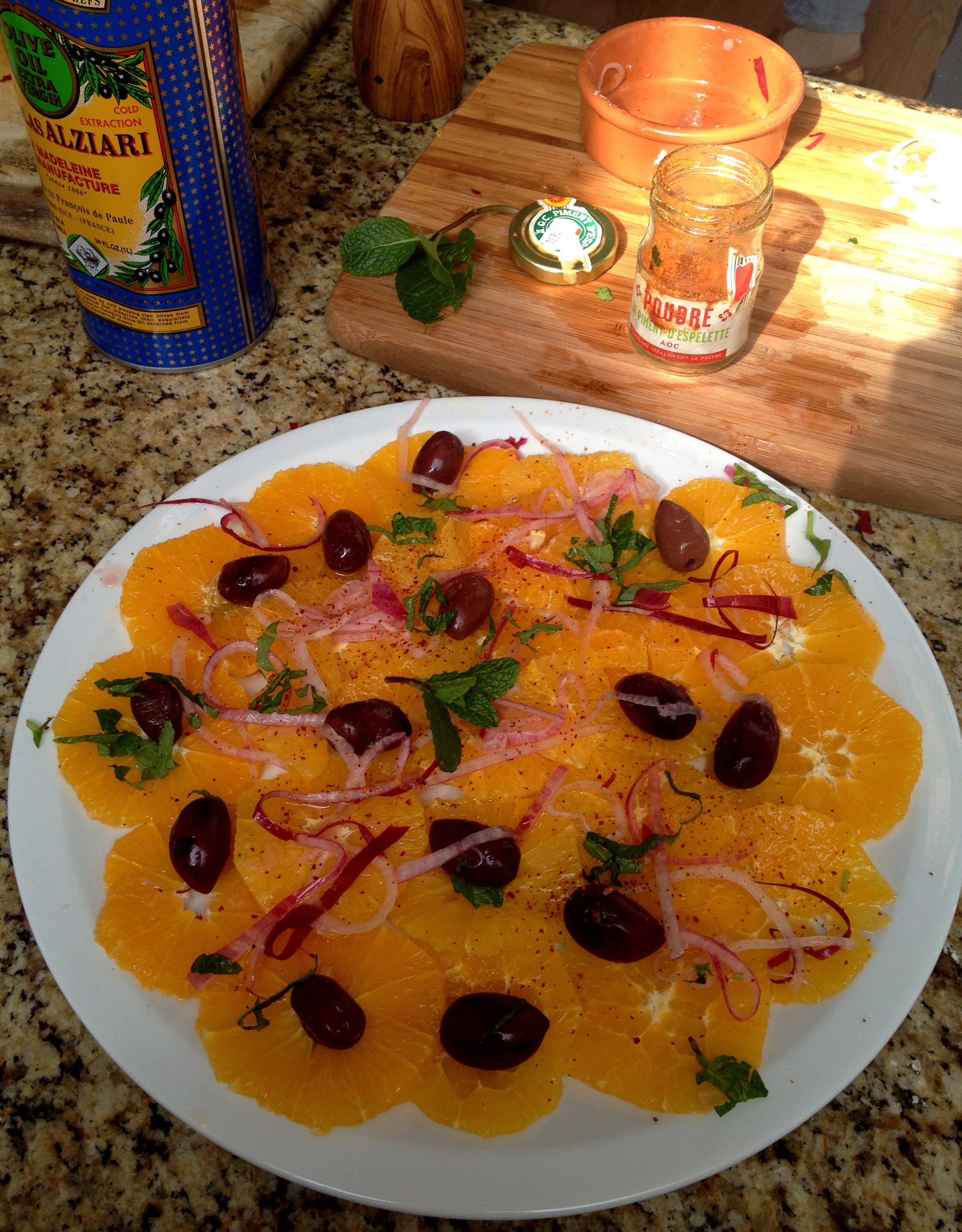
This is light and refreshing and, after a somewhat heavy or rich main course (like Moroccan couscous), it can serve as either salad or dessert. I like it best with black olives and mint, though you might prefer it on the sweeter side with orange flower water and dates and/or walnuts.  I sprinkle the oranges with Piment d’Espelette, a red chili pepper powder from the Basque region of France.  I always bring a bottle of it back from France because I can’t bear to be without it, but I recently discovered that you can order it online from Amazon.com and other food suppliers.  It isn’t cheap (a 1.4 oz. bottle costs $9.99), but if you’d like to add a sweet, smoky, mild chili pepper note to just about anything, this is more subtle than paprika or cayenne or any other chili powder.

Serves 4

Ingredients:

3 large navel oranges

1/2 small red onion, thinly sliced

1 teaspoon red wine vinegar

1  teaspoon olive oil

About a dozen black olives (preferably Kalamatas)

1 tablespoon chopped mint

1/2 teaspoon Piment d’Espelette (or paprika)

Salt

Put the sliced onion in a small bowl, cover with the vinegar and a pinch of salt.  Leave to macerate for 10-15 minutes, tossing frequently, to soften the onions.  Drain, saving the liquid. Add any juice you have over from slicing the oranges to it ,as well as the olive oil and  another pinch of salt.  

Peel the oranges, removing all traces of pith. Slice into thin rounds and arrange in circles on a large plate.

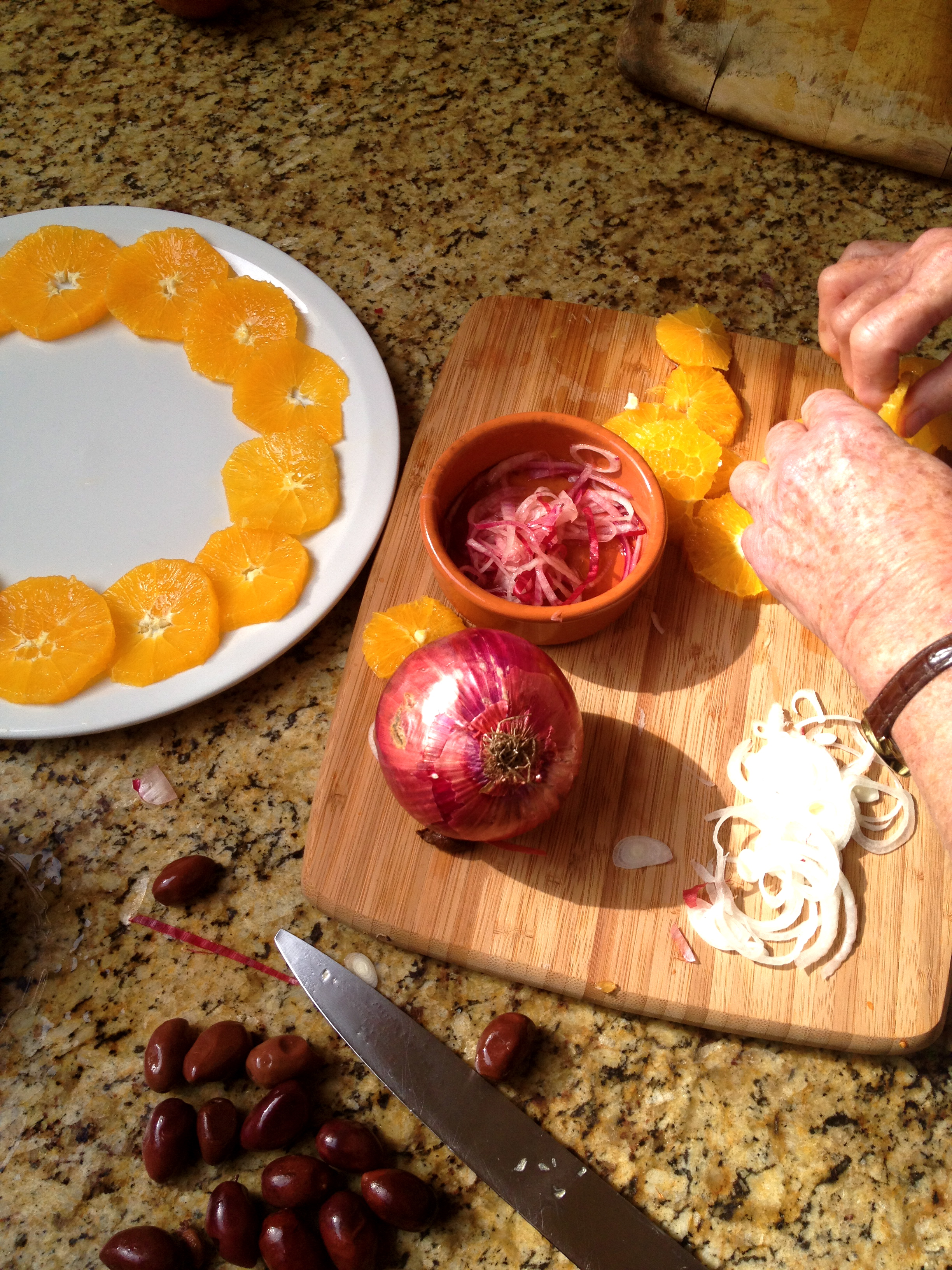
Pour the saved dressing over the oranges, decorate with the onions, mint, and olives.   Sprinkle with Piment d’Espelette, if you have it, or a light dusting of paprika. If the olives are large, cut them in half so that you don’t have too much olive on your fork when you compose a celestial bite of orange, onion, mint and olive. This will also give you the opportunity to pit the olives.

Variation:  An alternative is to sprinkle the oranges with orange flower water if available, a half teaspoon of cinnamon mixed with a half teaspoon of sugar and garnish the plate with chopped dates and/or walnuts.  A light and easy dessert.
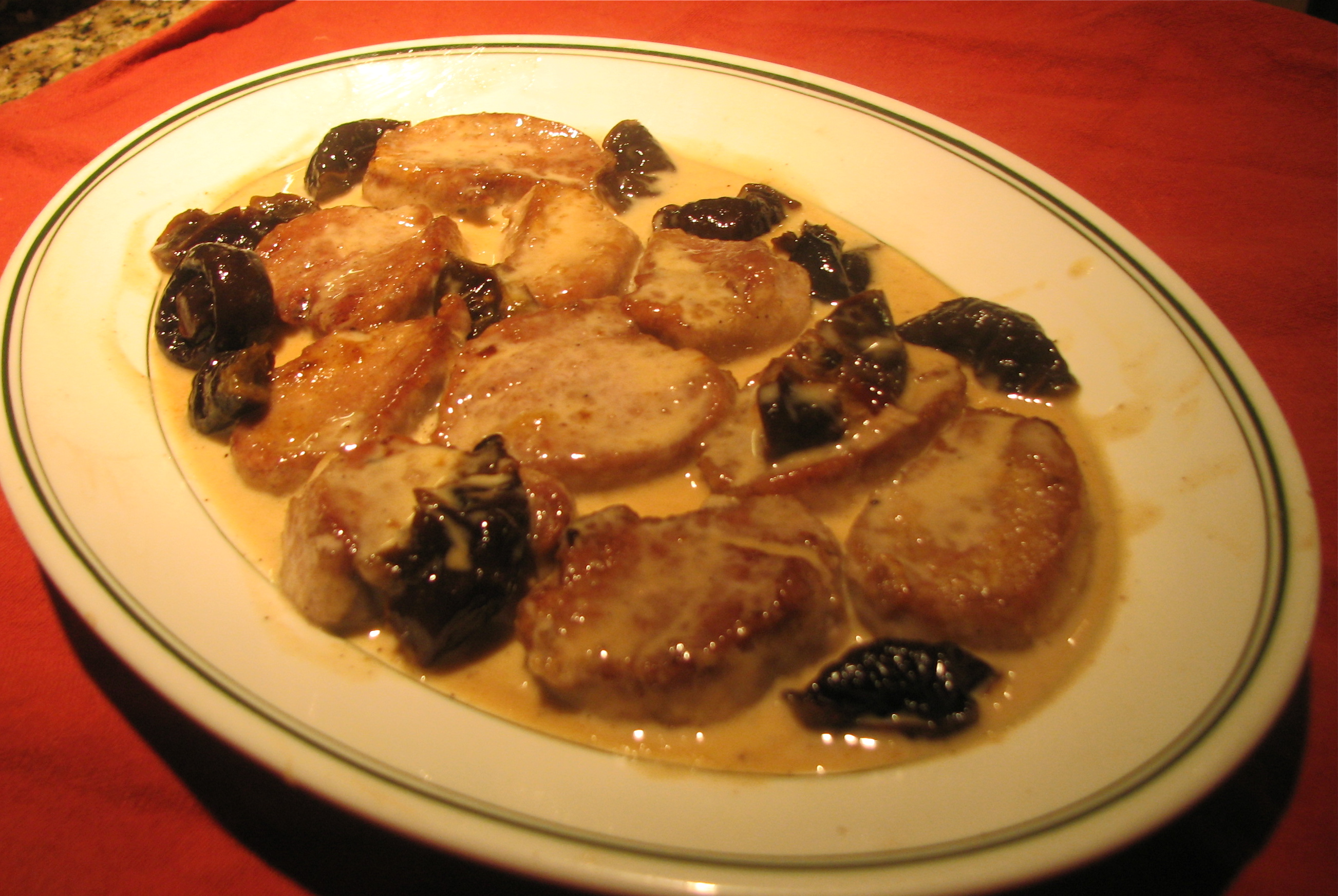
**Disclaimer: Sam had absolutely nothing to do with the abominable photo above. Sam was not on hand to take a photo when Jake made this dish, so Jake took matters into her own hands. And while we’re on the subject of abominable, Sam does not at all like prunes with her pork. Or prunes with anything, for that matter.**

Pork Tenderloin with Prunes and Cream

Please don’t be put off by the thought of prunes.  This is a really sumptuous dish, rich in flavor and appearance, and a breeze to make.  It’s from the area around Tours in France, renowned for its luscious prunes, although I find those from California to be equally delicious.  Pork tenderloin is the filet mignon of pork – not to be confused with pork loin – and is tender, cheap and low in calories.  I always have a few of them in the freezer ready to pull out to marinate for the barbeque or to turn into this dish, perfect for a special dinner. I recommend that, at least the first time, you make the dish for just two.  If you make it for 4 or 6 you  may need  to brown the meat in two skillets, and it gets a bit tricky.  Its one drawback is what to serve with it as it’s pretty rich and pasta or rice just don’t do it.   I usually settle for mashed potatoes although couscous is a good alternative.

Serves 2

Ingredients:

8 pitted prunes, cut in half

1 cup white wine (a chenin blanc or dry riesling would be best)

1 teaspoon each butter and vegetable oil

1 pork tenderloin, weighing about 12 oz.

1 teaspoon currant jelly (optional)

2 tablespoons creme fraiche or whipping cream

Soak the prunes in the wine for at least 3 hours or overnight.  Trim the tenderloin of any fat or membrane and cut it into 1/2″- 3/4″ rounds – you should have 10-12. Season with salt and sprinkle with flour (or shake them gently in a tablespoon of flour mixed with a teaspoon of salt in a plastic bag).  Have all your ingredients close at hand as the whole cooking operation takes about five minutes.

Heat the butter and oil in a heavy-bottomed skillet until beginning to brown.  Add the pork in one layer and cook until browned – no more than 2 minutes – then flip over and repeat on the other side.  Immediately remove the pork to a warm plate.  Add the prunes and their wine to the pan, let it bubble and reduce a little, add the currant jelly if you have it and then the cream.  As soon as it has thickened, put the pork back in, turn the heat down and let it all cook together for about another minute.  The sauce should be a lovely coffee-cream color.  Serve immediately. 

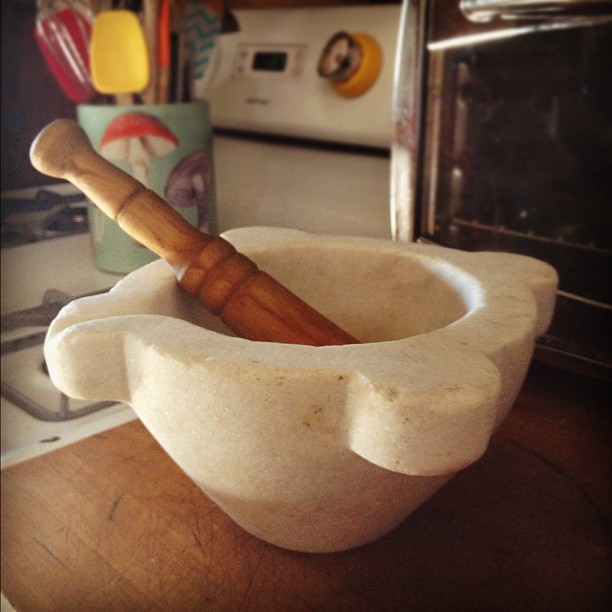
You may have picked up that I’m passionate about pestles and mortars.  I can’t remember when I got my first one but I have been grinding spices and making vinaigrettes and mayos and aiolis and pesto in one or another since I started cooking.   There’s something very satisfying about pounding and turning and watching your creation slowly come to life before you.

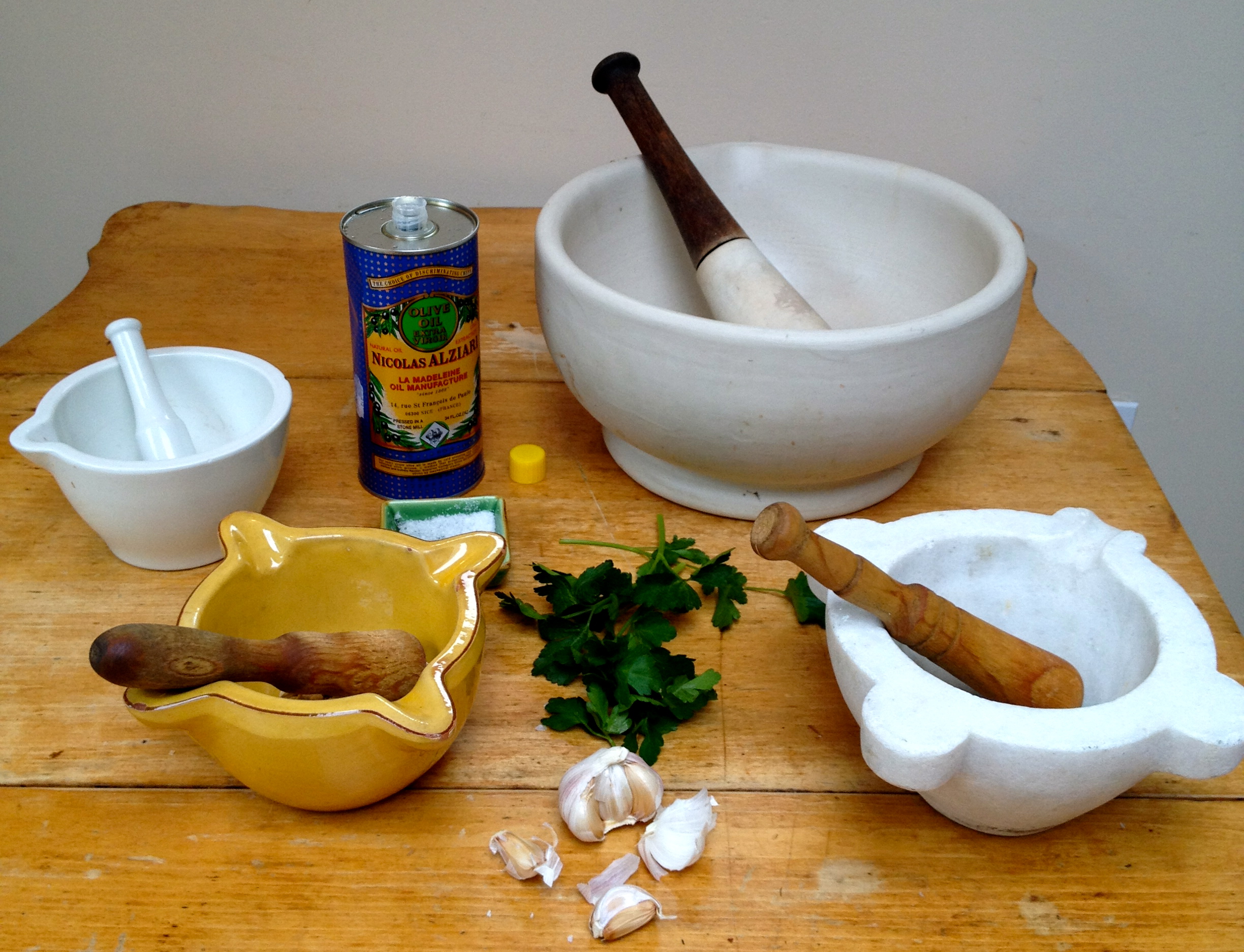
Here is a picture of some of my p&m’s (I have more at our home in France). The biggest one I acquired when we were living in London in 1990. I was at the Bermondsey Market one Friday shopping for antiques with a couple of friends when I came upon it in all its grandeur and beauty.  I did not stop for a moment to consider what I might use it for, nor did I consider what it might weigh (just shy of 40 lbs). I had to have it.

We had come to the market by bus but the plan was to walk back across Tower Bridge and thereafter take the Underground home.  I began to feel it about half way across the bridge – my knees started buckling and my arms feeling stretched to the ground.  By the time we reached the Underground I was really suffering.  A change of tube lines and a further quarter mile home and I was practically crawling.  But I had my beautiful pestle and mortar.

Nowadays, it sits regally on the kitchen counter.  I seldom move it, even to make an aioli.

Aioli

Aioli is garlic mayonnaise. It is probably the most beloved of all Provençal dishes and each summer Le Grand Aioli is the centerpiece of meals held at festivals throughout Provence.  But more about that at a later time.

In the meantime, here’s a simple recipe to make about a cup of this voluptuous golden sauce to douse generously on vegetables, frites, fish, or anything else you might deem appropriate.

Ingredients:

2 medium garlic cloves, peeled

good pinch of salt

one egg yolk at room temperature 

2/3 cup olive oil

1/3 cup vegetable oil

Pound the garlic and salt until you have a paste.  Add the egg yolk and stir it around with the pestle until amalgamated.

Mix the oils in a suitable small jug or any vessel with a small spout.  Start adding the oil to the egg mixture, very slowly and rhythmically, drop by drop, until it starts to make a sort of sucking sound as you move it around and up the side of the mortar.  Keep going slowly until you’ve used about half the oil (your arm will be falling off so we find that one person pouring and the other stiring, taking turns,  is the answer).  By the time you’ve used up half the oil, it should have “taken” and you can start pouring more rapidly. You should end up with a fairlly solid mass – the pestle will stand upright in it.  Check for salt and add a teaspoon of lemon juice if you like (I don’t).

If, despite all precautions, it separates, you will have to remove the mess from the mortar, clean it out, put in another egg yolk and, little by little, add the unsuccessful aoili, while turning the pestle constantly, hoping for better luck the second time around.

How, you might ask, can anything possibly be worth all this trouble?  Once you’ve mastered it, you’ll never look back.

The weather has been so un-winterlike in San Francisco that it’s been hard to think about hearty stews and robust soups.  This past weekend, however, cold weather and rain finally arrived, so it’s time to break out some pulses – beans, barley, lentils and split peas. Here are three nourishing soup recipes that will warm you up, wherever you may be.

Scotch Broth

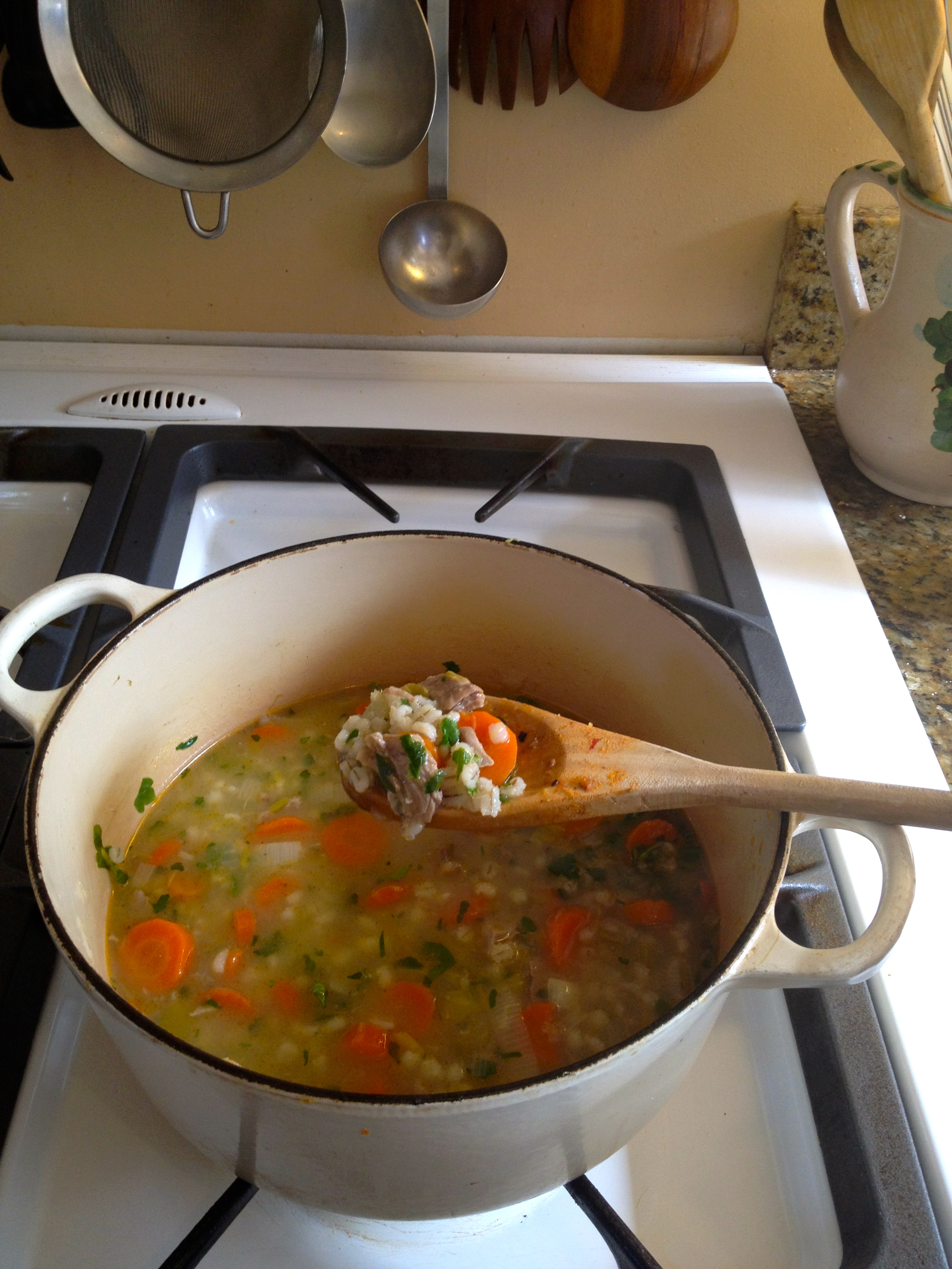
This is, not surprisingly, an old Scotch recipe.  Its appearance is somewhat murky, and barley can be, well, slimey. However, it’s one of those hearty soups that speaks of the pleasures of winter fare at its best.

I like to make it with just lamb, onions, carrots, a leek or two and barley, but you can add turnips, parsnips, even cabbage and potatoes if you like to make it a more of a stick-to-your-ribs stew.

Serves 4

Ingredients:

6-8 cups water

2 shoulder lamb chops (or a lamb shank)

a few sprigs fresh thyme 

3″ piece celery

2 bay leaves

1/2 cup barley

1  onion, chopped

1 leek, white and pale green parts only, sliced in rounds

4-5 carrots

2 tablespoons parsley, chopped

Put the lamb, thyme, celery and bay leaves in a suitably large pot and cover with water, to which you’ve added a good teaspoon of salt. Bring to the boil and skim off the scum that rises to the surface, continuing to skim if necessary.  Simmer gently for 60 minutes then strain, discarding the herbs and setting the meat aside.  Return the liquid to the pot, adding the barley, onion, leek, and carrots and continue to cook at a bare simmer.  Once the lamb is cool enough to handle, remove the bones, chop it and put it back in the pot. Continue to cook until the barley and vegetables are tender (a total of 30-40 minutes since they were first added.)  The soup should be thick but not solid. Add more water along the way if necessary.  Add the chopped parsley, salt if necessary, a good grinding of pepper, and serve piping hot.


Black Bean Soup

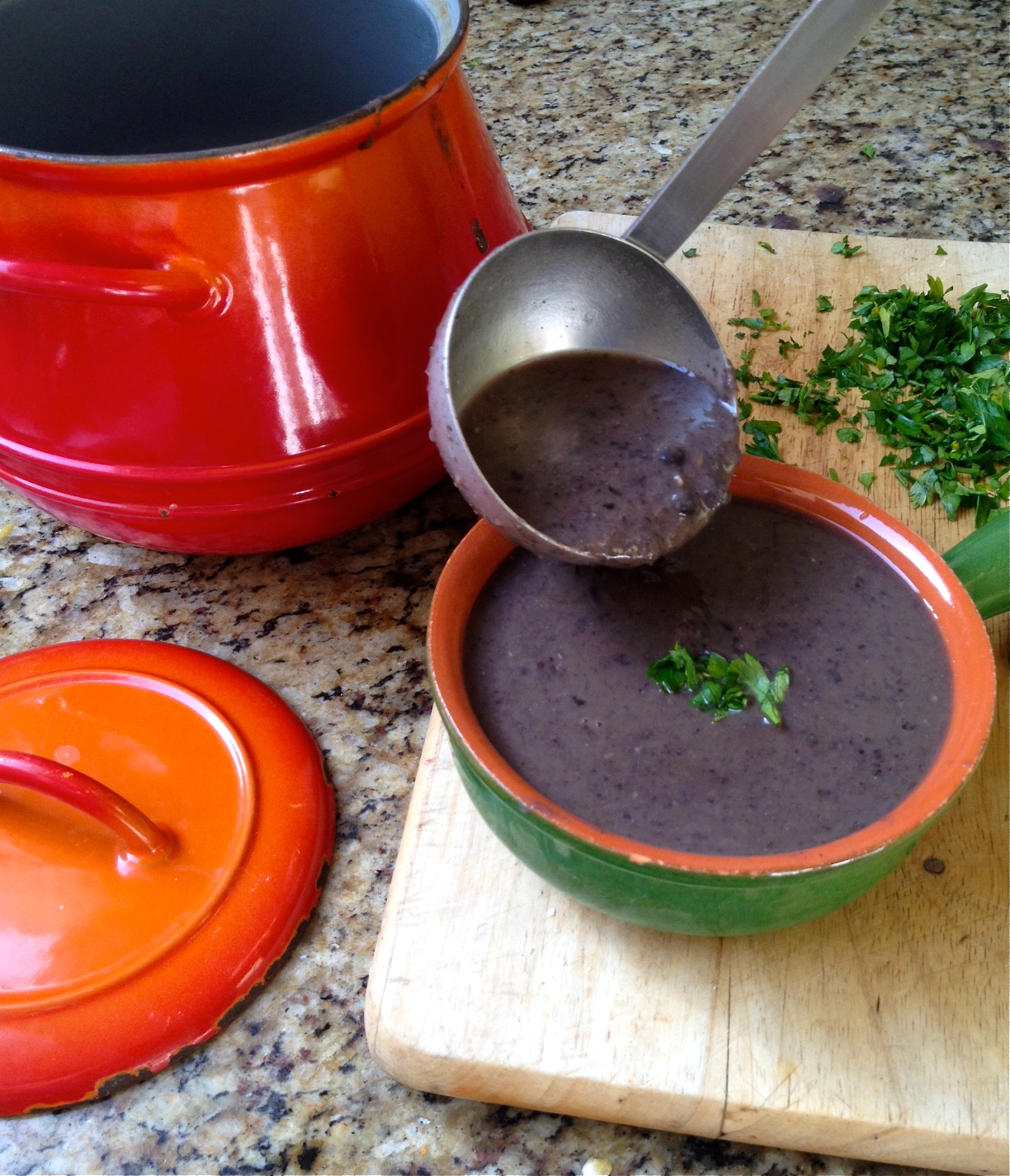
After I’d made this soup and Sam had photographed it, it struck me that everyone knows how to make black bean soup, right? Or, if not, you can’t go far wrong following the recipe on the bag of beans. So if I don’t have anything particularly illuminating to add (and I don’t) what’s my excuse for writing about it? Well, we do have a nice photo, black bean soup is so cheap and cheerful, it’s perfect on a cold, blustery night, and maybe it’s slipped off your radar and you’re happy to be reminded of how simple and easy it is to make.

Serves 6-8

Ingredients:

1 pound dried black beans

8 cups water

1 teaspoon vegetable oil

2 rashers bacon, chopped (optional)

1 large onion, chopped

2 cloves garlic, chopped

2 bay leaves

1 tablespoon ground cumin

1/2 teaspoon cayenne

Juice of 1/2 lime, salt

Sour cream and chopped cilantro for garnish

Soak the beans overnight in cold water to cover by 2 inches, or bring the beans to the boil in a large enough pot, boil for 2 minutes, cover and leave for at least 2 hours.  Drain the beans.  Saute the bacon in a little oil until almost crisp, add the onions and garlic and continue to cook for another few minutes (or if you’re not using the bacon, just saute the onions and garlic in the oil).  Add the drained beans, bay leaves, cumin and cayenne,  and again cover with water by about 2 inches.  Bring to the boil, skim if necessary, turn down the heat  and simmer until the beans are just cooked.  Cooking time will depend on how fresh (or old) the beans are, anywhere from one to two hours.  You’ll need to keep checking after the first hour.  When cooked, add salt, the lime juice and if you think it needs to be jazzed up a little, a bit more cumin and cayenne.

Put about half the beans and some of the liquid in a food processor or blender and blend until smooth.  Return to the pot and mix well with the rest of the beans.  Serve hot, garnished with a dollop of sour cream and a sprinkling of cilantro.

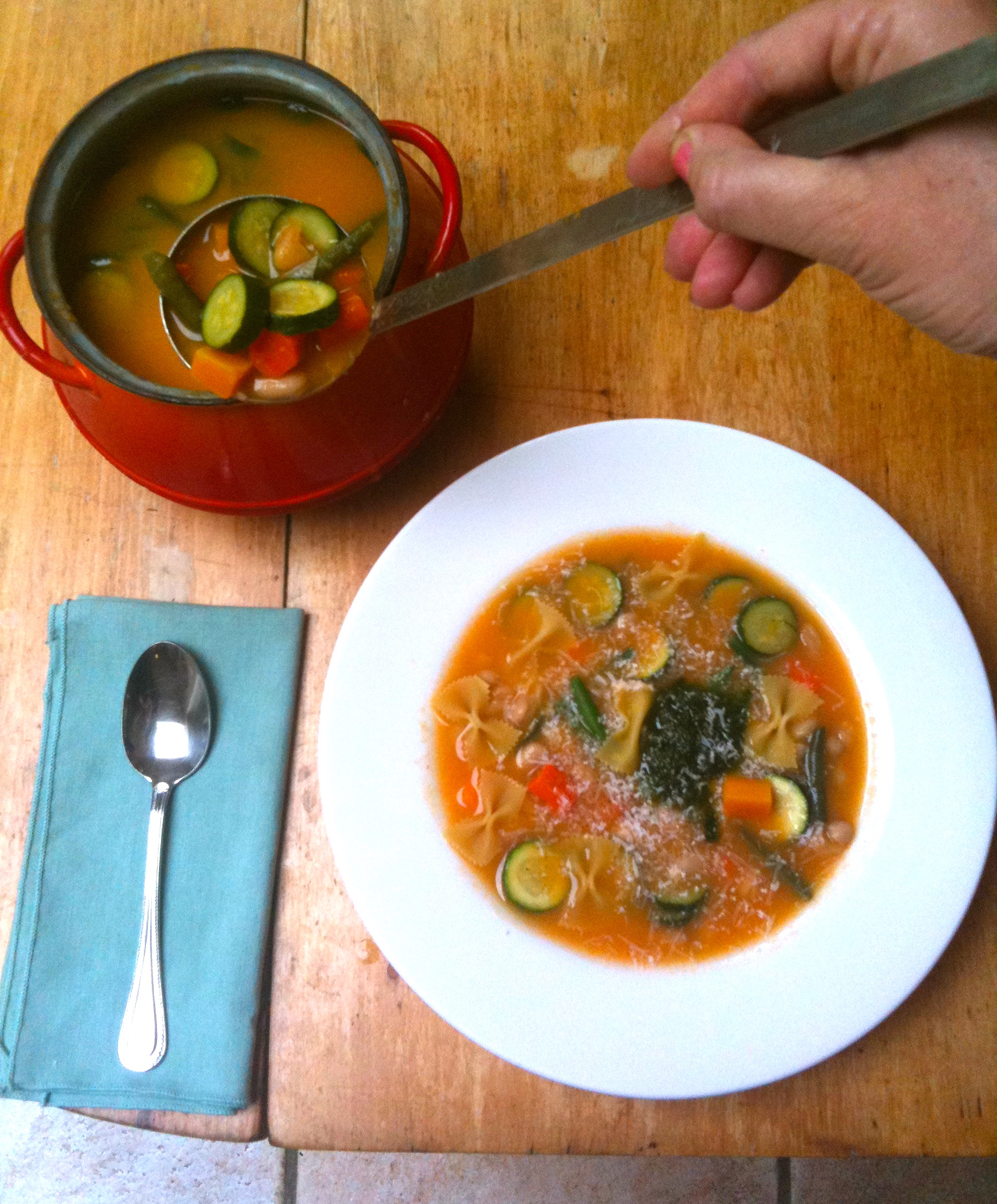
Soupe Au Pistou

This is Provençale minestrone, pistou being the local word for pesto.  It’s more often an end-of-summer soup made when vegetables are at their peak, basil is abundant, and fresh shell beans such as cranberry (cocos in French) make their brief appearance. I make it year ’round because it is probably my very favorite hot soup, bar none.  I am quite rigid about what vegetables to use – leeks, carrots, potatoes, green beans, zucchini and butternut in winter –  and then I add canned canellini (often sold as “white kidney beans”) and pasta, cooked separately.  In summer I add a lovely ripe tomato (sometimes to the soup, sometimes to the pesto) and fresh shell beans instead of the canned.

Serves 4-6

Ingredients:

2 medium potatoes, such as Yukon Gold, peeled, cut in half

5 carrots, 2 fat and mature cut in half, 3 skinny and young, cut in 1/4″ rounds

2 leeks, white and pale green parts only, left whole

1/3 lb. green beans, sliced into 1″ pieces

1 cup butternut squash, chopped into 1/2″ dice

4 small zucchini, sliced into 1/4″ rounds

1-14 oz. can canellini beans (or 2 if you’re not using pasta)

8 cups water

Salt, pepper

1/2 cup elbow or farfalle pasta 

For the pistou:

2 cups basil, stems removed

2 cloves garlic

1/2 cup olive oil

1 ripe tomato (in summer, peeled)

Salt

Parmesan cheese to grate at the table

The way I make this and other minestrone-type vegetable soups is somewhat unconventional.  I learned it in the restaurant Lou Pastrouil in Nice, when I was cooking around Europe in the sixties.  Lou Pastrouil was a simple place in the old town decorated with fishing nets and copper pots. I spent a week there as an (unpaid) apprentice, getting acquainted with the pleasures of Provençale food.  In addition to the rustic pork pâté, stuffed sardines, and wonderful mussels for the first course, there were two soups on the menu – soupe de poissons and soupe au pistou. The elderly woman who was the cook showed me how she vigorously mashed some of the veggies against the side of the pot to give the soup body instead of letting the liquid remain, in her words, like dishwater. I have done this ever since, though nowadays with the help of a food processor. It really does make a richer soup.

Sadly Lou Pastrouil no longer exists, a busy Bar-Tabac has now taken its place, the aroma of its exhilirating food long gone.

Put the potatoes, the two large carrots, and the leeks in the water in a suitably large pot. Salt the water and bring it to the boil.  Cook until the veggies in the pot show some resistance to a knife (about 5 minutes after the boil).  You’re now going to add the other veggies at intervals so that the’re all perfectly cooked at the same time:  First the sliced carrots, then the beans, then the butternut, then the zucchini, then the canned beans, with a few minutes between each addition.  This may seem like a lot of trouble, but it really makes a difference to have each vegetable cooked right and not too mushy nor too bitey.  Five minutes after the last addition, turn off the heat, and fish out the potatoes, carrots and leeks.  Process them (in two batches if necessary) in a food processor or blender with enough liquid from the pot to prevent the potatoes from becoming sludgey.  When you have a smooth purée, add it back to the pot and reheat the soup.

Cook the pasta separately until al dente and add it to the soup after it’s reheated.

While the soup is cooking, make the pesto. In a mortar, pound the garlic with a pinch of salt  and gradually add the basil, pounding it to a paste. If you’re using a tomato, add it now and continue to pound.  Otherwise add the olive oil progressively until you have an unctuous thick sauce, not quite an emulsion.  I leave out the usual parmesan as I prefer to add it directly to the soup at the table.

Of course, you can make the pesto in a food processor or blender. But, if you don’t own a pestle and mortar, I strongly urge you to invest in one (preferably marble or porcelain with a wooden pestle..like this one, for example). Using it  to make pesto and mayonnaise and salad dressings is a most rewarding experience, not to mention yielding a finer end product.

Finally, to serve: Ladle the hot soup into large bowls. Bring the pistou to the table in its mortar, swirl a tablespoon (or two) into each bowl, add grated parmesan, a grind of pepper and prepare to be astonished by its goodness.

Like the two previous soups, this one benefits from being allowed to sit for a day. So if you can resist eating it immediately, cook the pasta and make the pesto right before you plan to eat it.

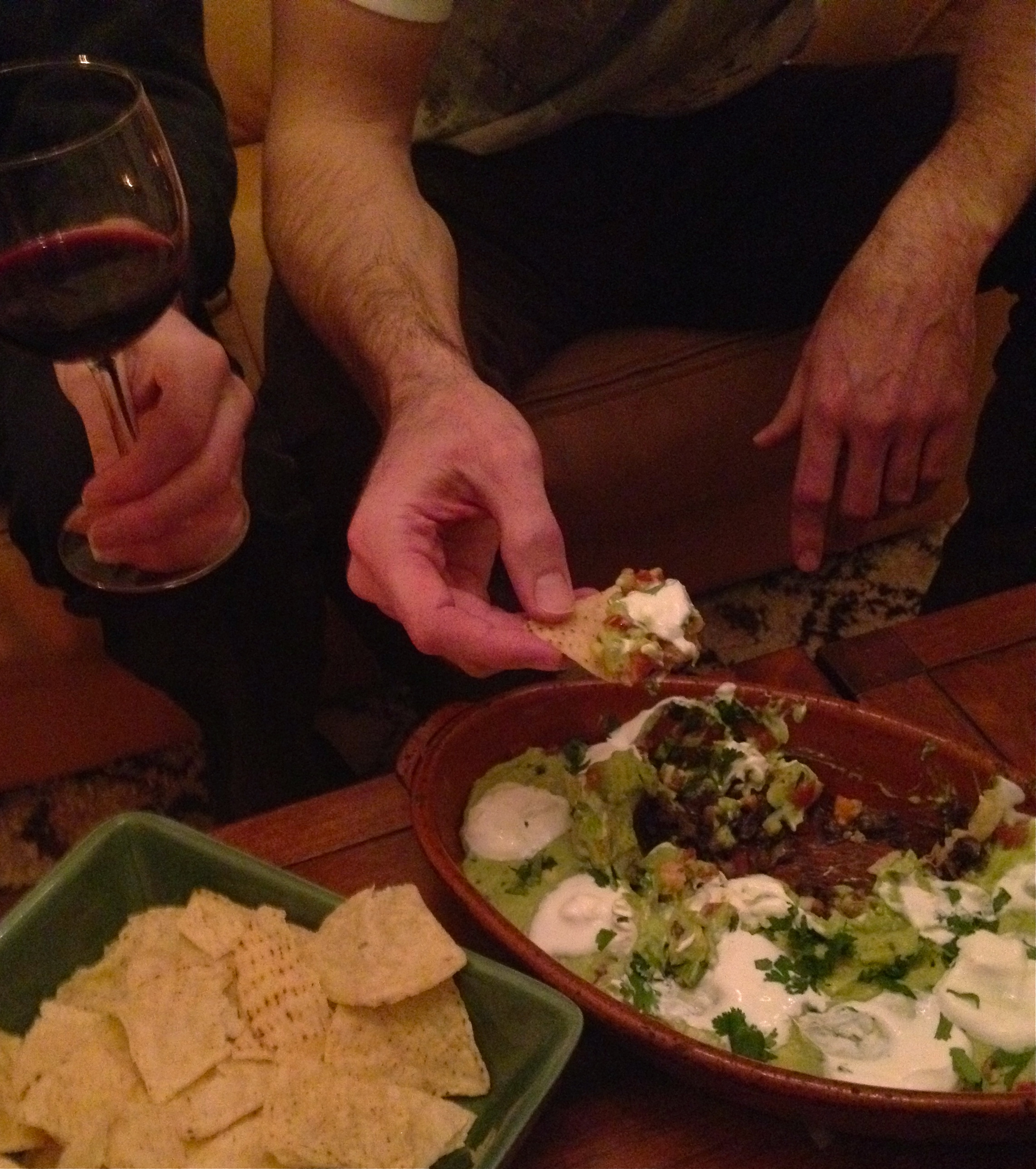
I just read that Super Bowl Sunday is the second largest food consumption day of the year in the U.S. (Thanksgiving being the first.) It must certainly be the unhealthiest: a license to indulge in the greasiest, saltiest, most calorific, cardiac-arrest-inducing offerings without guilt, all in the name of a football game. (We’re huge football fans around here.) No grilled chicken breast-Caesar salads but rather Buffalo chicken wings with blue cheese sauce, ribs, chips and dips, and, of course, chili. Not to be left out, I offer my recipe for both chili and a four-layer dip (seven layers have too many flavors, we think) which we have always called Plate o’ Slop.  This could, of course, be scooped up with carrot and celery sticks, but it really is much better mounded atop the best tortilla chips you can find. (We favor these.)

Plate O’ Slop

Serves: However many, until gone

Ingredients:

For the bean layer:

3-15 oz. cans black beans

1 tablespoon ground cumin

1 tablespoon chili powder

1 teaspoon garlic, finely chopped (do 3 at once, one each for the beans, salsa and guacamole)

Juice of 1 lime, salt

For the tomato salsa:

6-8  tomatoes (the ripest you can find), cubed

1 jalapeño pepper, finely chopped 

1 teaspoon garlic, finely chopped

1 tablespoon chopped mild onion, red or white

Salt, pinch of sugar

1 tablespoon cilantro, finely chopped

For the guacamole:

4 ripe avocados

1 teaspoon garlic, finely chopped

1 jalapeño pepper, chopped fine

1 tablespoon lime juice, salt

To assemble:

1 8 oz. pot sour cream

1/2 cup chopped cilantro

The ingredient list is long but there is a lot of overlap and, if you use a food processor, it comes together in no time at all.

For the  bean layer:  Put them in a pot with all of their liquid, the cumin, chili powder, and garlic.  Cook for about 10 minutes until the flavors are blended and most of the liquid has evaporated.  Mash the beans against the side of the pot or put the mixture in the food processor and pulse three or four times until you have a spreadable mixture – about half beans, half thick puree. 

For the tomato salsa:  Mix all the ingredients.  Let drain in a colander until ready to assemble the dip.

For the guacamole:  Either mash the avocados coarsely and add the rest of the ingredients or pulse everything in a food processor, stopping short of having a smooth mixture.

Assembling the dip:  Spread the beans on the bottom of an approximately 9″ x 12″ dish.  Cover with the drained salsa, then the guacamole, then about a 1/2″ of sour cream.  Sprinkle with the cilantro and devour.

Chili

There are probably more “award winning” recipes for chili than any other food item in existence, and people tend to think their recipe is the best. I don’t have any such illusions, but mine is fairly flexible in its ingredients, relatively easy to make, and has pleased family and friends for about 50 years. With regard to its “heat “and that of the dip, I leave it to you to decide how spicy you want things to be, particularly if kids are involved. You can always add hot sauce or extra chiles. As for the chocolate and the beer, I list them as optional because while I do think they add richness and complexity, if you don’t have them on hand you will still have a very flavorful chili without them.

Ingredients:

2 lbs. regular ground beef (20% fat)

1 pound lean ground pork (or use 3 lbs. ground beef)

1 cup chopped onion

1 tablespoon garlic, chopped fine

3 tablespoons chili powder

1 tablespoon ground cumin

1 tablespoon dried oregano

1 teaspoon cayenne pepper

1 teaspoon paprika

1 tablespoon salt

1-28 oz. can tomatoes, chopped

1-12 oz. can dark beer (optional)

3-15 oz. cans red kidney beans

1 oz. dark chocolate (optional)

Brown the meat in 3 batches over medium heat, draining each batch of most of its fat after browning. (I just tip them into the same colander, saving about a tablespoon of  fat for the onions.)  Cook the onions until softened (about 5 minutes) then add the garlic, the meat, all the spices and the salt.  Continue to cook and stir over medium heat for a few minutes until the meat has absorbed the spice flavors.  Add the tomatoes and the optional beer (or replace it with water).  Make sure the liquid just covers the meat mixture, adding more water if necessary.  When it comes to the boil, turn the heat to low and let it simmer for at least an hour, adding more water as needed to keep the liquid level just covering the meat.  It is important to taste as you go, making sure that it has the heat and chili flavor that you want, as well as enough salt.  Chili powders vary a great deal so you may want to add more at an early stage, or more cayenne, or a chopped jalapeño or two. 

Drain and rinse the beans and add them after the meat has cooked for an hour. 

Add the chocolate about 10 minutes before the end of cooking (earlier, it won’t add much to the flavor).

I like to serve the chili with rice and have bowls of guacamole, salsa, and sour cream available for garnish (you can make extras when making the Plate o’ Slop), but I recognize that these might not be your first choice.  So feel free to serve your chili with grated cheese, chopped onion, tortilla chips, corn bread, or whatever else suits your fancy. 

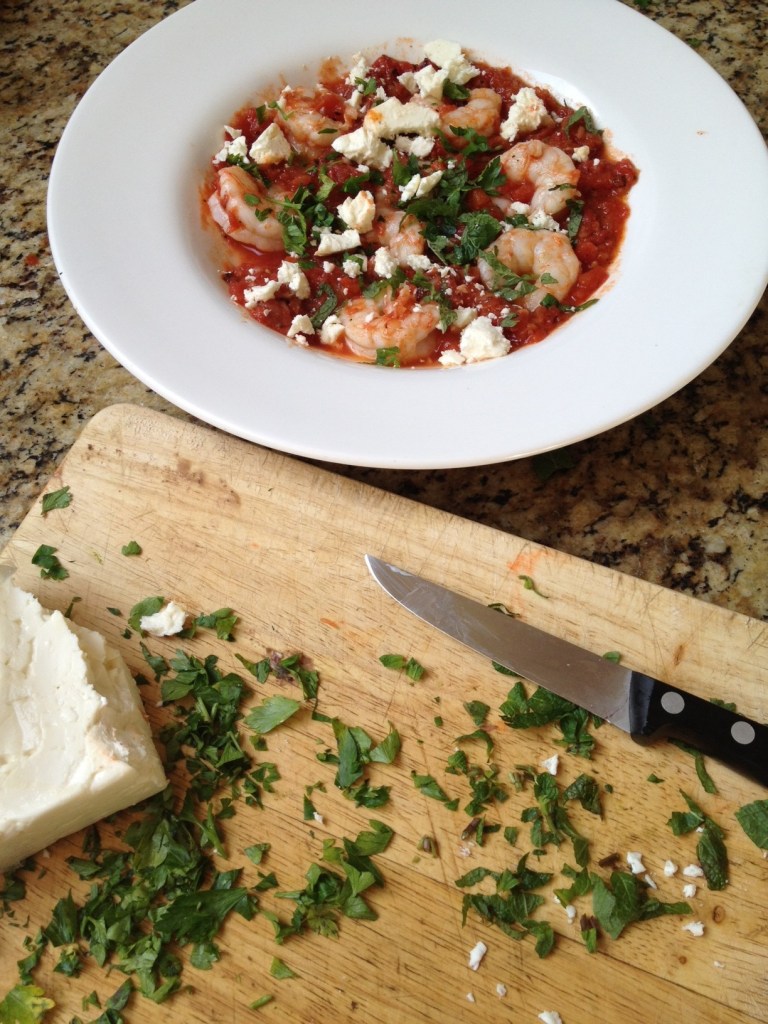
Shrimp with Feta and Tomatoes (Garides Saganaki)

This dish is robust and full of flavor – the sweet tomato sauce contrasting nicely with the salty cheese and the bitey shrimp. It’s also very easy to make and festive enough for a dinner party entree. Garides is the Greek word for shrimp and saganaki is the pan in which it is baked. But I simply make the dish in a skillet on top of the stove.

To tell the truth, when I lived on a Greek island for six months in the 60’s, I never once ran into this dish. Greece, like most of Europe, was quite poor at the time and fish were sparse in the Mediterranean – it had been “fished out” people said. Octopus was plentiful, but the arrival of a couple of barbounia (red mullet) in the market was cause for celebration and quick acquisition.

How things have changed. With the farming of fish worldwide, shrimp is readily available in a mutitude of shapes and sizes. I know that fish farming is detrimental to the environment, but I can’t help being glad that at least shrimp and prawns are not priced beyond reach — or that they’re not nearing extinction.

Serves 4

Ingredients

2 tablespoons olive oil

1 small onion, finely chopped

2 garlic cloves

1/2 cup white wine (or 1 tablespoon ouzo if you have it)

1 14-oz. can chopped tomatoes (or use fresh if they’re in season)

1 teaspoon dried oregano

salt and a pinch cayenne pepper

1-1/2 pounds peeled and deveined shrimp (the larger the better)

4 oz. good feta cheese

1 tablespoon fresh mint, chopped (or dill or parsley)

Saute the onion in the olive oil in a heavy-bottomed skillet until soft.  Add the garlic and white wine or ouzo.  

Ouzo gives a slightly different, licorishy flavor but is more authentically Greek. Let it bubble and reduce, then add the chopped tomatoes, drained of most of their juice, a little salt (the feta is salty), the cayenne and dried oregano and cook over low heat until the sauce is slightly thickened and almost dry. Add the shrimp and cook briefly (3-5 minutes, depending on size).  Do not overcook. Add the feta and give it a minute to melt slightly, then add the chopped mint, or dill if you prefer. I like to serve this dish with simple boiled white rice and buttered spinach, but even on its own it will be sure to satisfy.

January is the month that many of us are dismayed when we look in the mirror. So, hoping for a miracle, we seek out healthier food.  I avoid the term “comfort” food because it brings to mind macaroni-cheese, mashed potatoes and that image in the mirror. So, what I’m aiming for are dishes that won’t necessarily knock off all those extra pounds but at least make a stab at “eating healthily” and, equally important, provide some delicious and different meals at the same time.  Here are four vegetarian dishes of diverse origins – Italy, Catalonia, Mexico, and Provence. They don’t go together, but each is easy to make and won’t break the calorie bank.

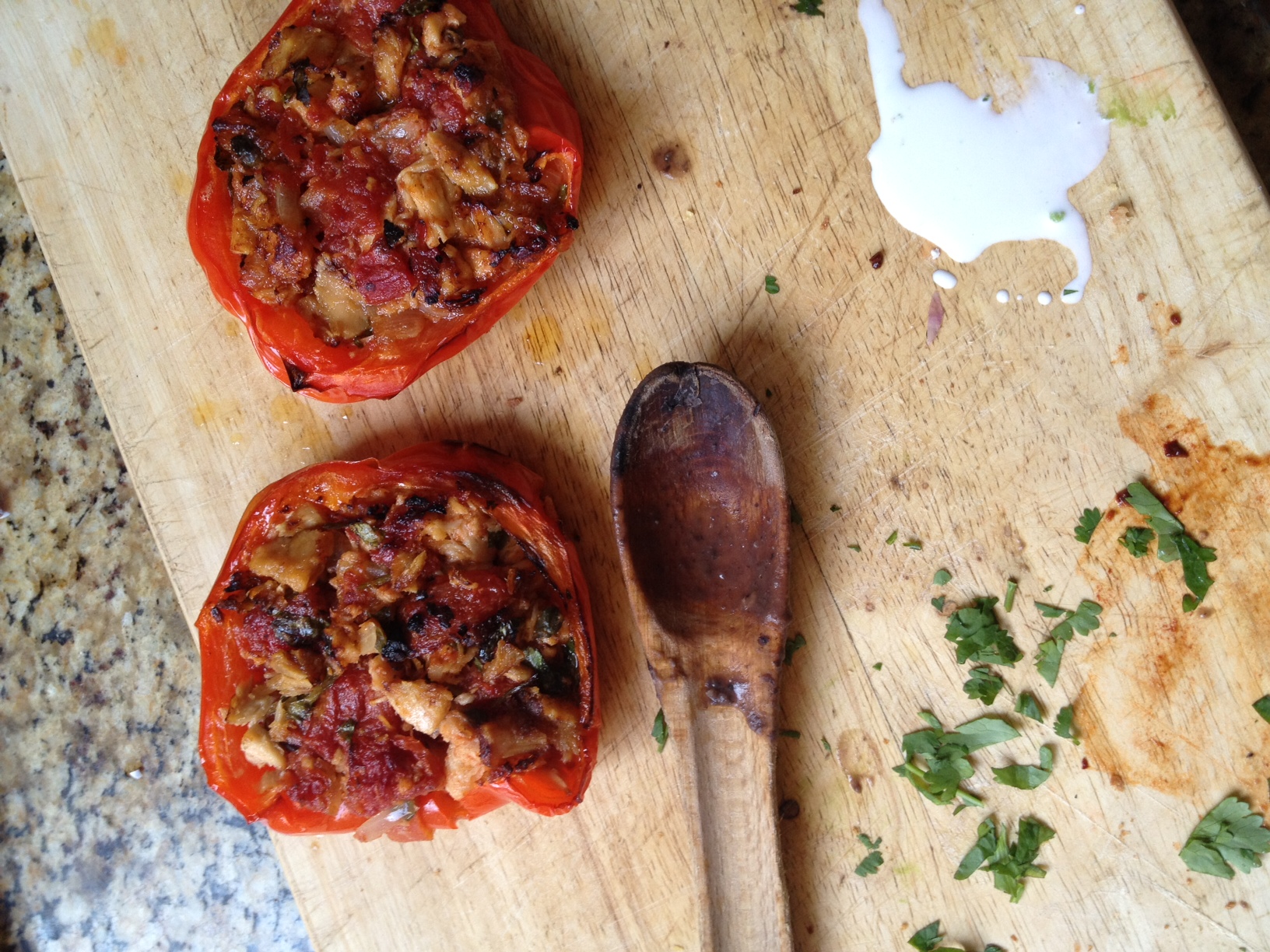
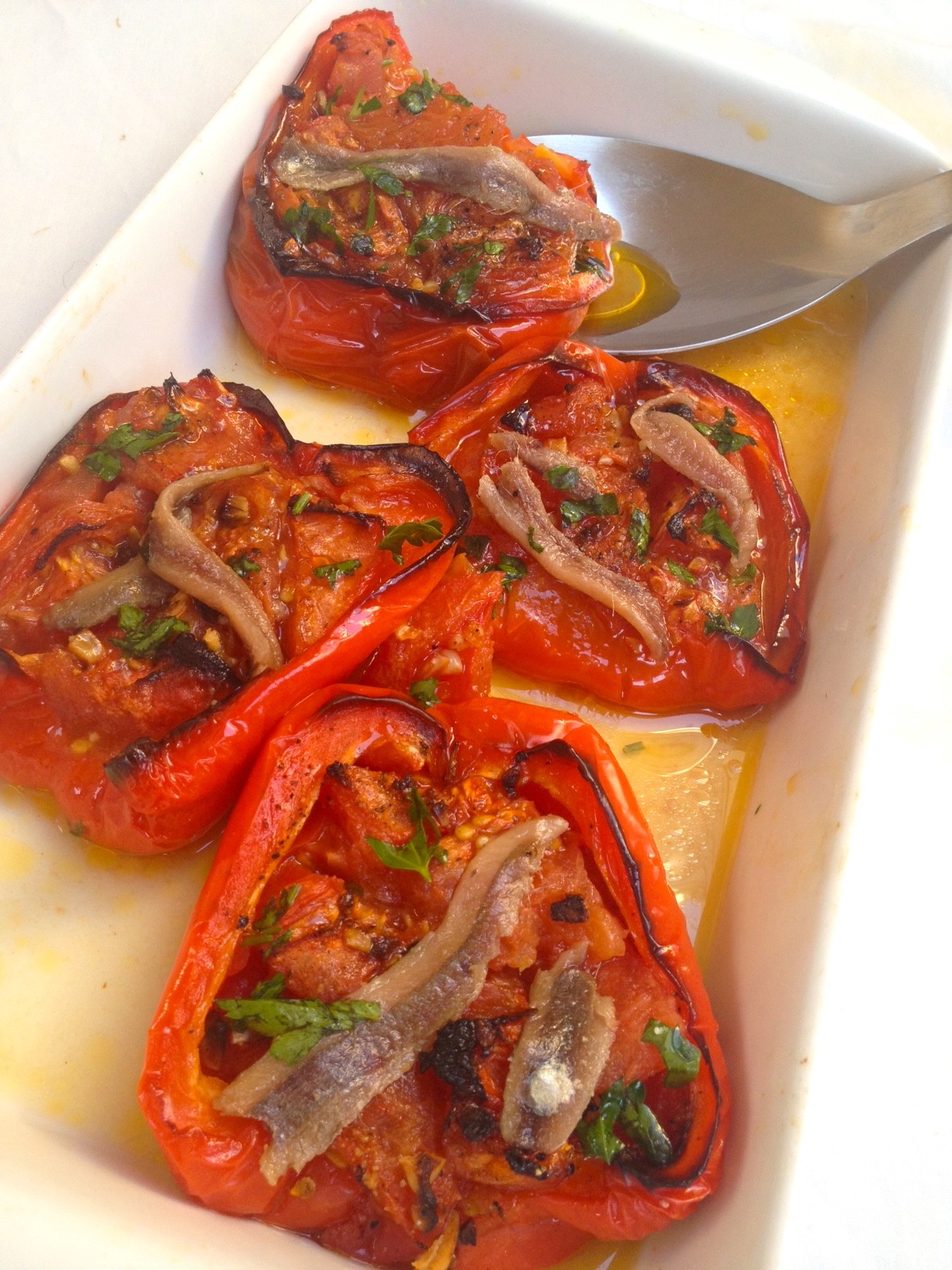
Piedmontese Peppers

These are perfect for a light meal with – dare I say it – crusty bread to mop up the wonderful juices.  Although it might be hard to find perfect tomatoes at this time of year, even less perfect ones will improve in flavor in their garlic-olive oil cocoon.

Serves 4 (2 halves per person)

Ingredients:

4 red peppers (these should be symmetrical, not deformed)

2 large garlic cloves, chopped

8 ripe plum tomatoes, skinned, halved and lightly salted

1/2 cup olive oil

1 can anchovy fillets

Preheat the oven to 350 degrees.  Halve the peppers and remove the stem, core and seeds.  Season each pepper half with salt and pepper and 1/8 of the garlic.  Distribute the tomatoes evenly among the peppers, squishing them down a bit to almost fill the peppers.  Place in a roasting pan and pour about a teaspoon of oil over each pepper, pouring any leftover oil into the pan.  Bake for about an hour until the edges of the peppers are slightly blackened.  Remove from the oven, let cool a bit, and distribute the anchovies evenly over the surface of the peppers. These are best served warm and are fine reheated the next day.

Postscript: After I had written this, I got to thinking about people who loathe anchovies and whether there was an alternative.  So I sauteed a tablespoon of onion in olive oil, mixed it with about half a cup of canned tomatoes (I used Hunt’s fire roasted, diced, which I particularly like), half a can of drained and flaked tuna, a teaspoon of  capers, a little garlic and salt and pepper.  I stuffed two pepper halves with the mixture, doused them each with a teaspoon of olive oil and baked them in the same way.  Here is Sam the Taster’s reaction: Delicious!  I happen to love both anchovies and tuna, so I liked them both, but the peppers with anchovies definitely had more flavor…if you can’t stand anchovies, I suggest you mix the tuna well with the oil and capers and other ingredients so it absorbs as much flavor as possible.

Mushrooms, Green Beans, and Blue Cheese

We had this dish about 20 years ago in a popular restaurant in Barcelona called Señor Parrelada. It is still going strong, serving fine and reasonably-priced food. We have been making it ever since because it’s both unusual and delicious. The ingredients don’t seem intrinsically Catalan or even Spanish, but the original version was made with Cabrales, a strong blue cheese from the Asturias region in NW Spain. I use any good blue cheese that I have on hand. We serve this as a separate course or as an accompaniment  to something fairly plainly cooked, like a steak, pork chop, or grilled chicken breast.

Serves 4

Ingredients

3/4 lb. green beans (preferably haricots verts, if available)

1/2 lb. mushrooms (white, brown or shiitake)

1 teaspoon olive oil or butter

2 oz. blue cheese, crumbled

Foil for baking

Preheat the oven to 350 degrees. Top, tail and halve the beans and cook them in boiling, salted water until still slightly crisp.  The cooking time will depend on the size and quality of the beans.  Slice the mushrooms into 3 or 4 pieces and saute them over fairly high heat in the oil or butter until lightly browned and almost cooked (3-4 minutes), adding a good pinch of salt on the way. Have ready a 12″x12″ piece of foil.  Place the beans and mushrooms on the foil, season with pepper and a little more salt, and scatter half the cheese on top. Fold the foil over the mixture to make a secure package. Bake for 10 minutes until the cheese has melted and the beans and mushrooms are cooked to your liking. I say this because some people like their beans almost raw while we prefer them just barely crisp. Sprinkle with the rest of the cheese and serve, preferably still in its foil wrapper. The marvelous aroma as you open the package will send you to the moon.

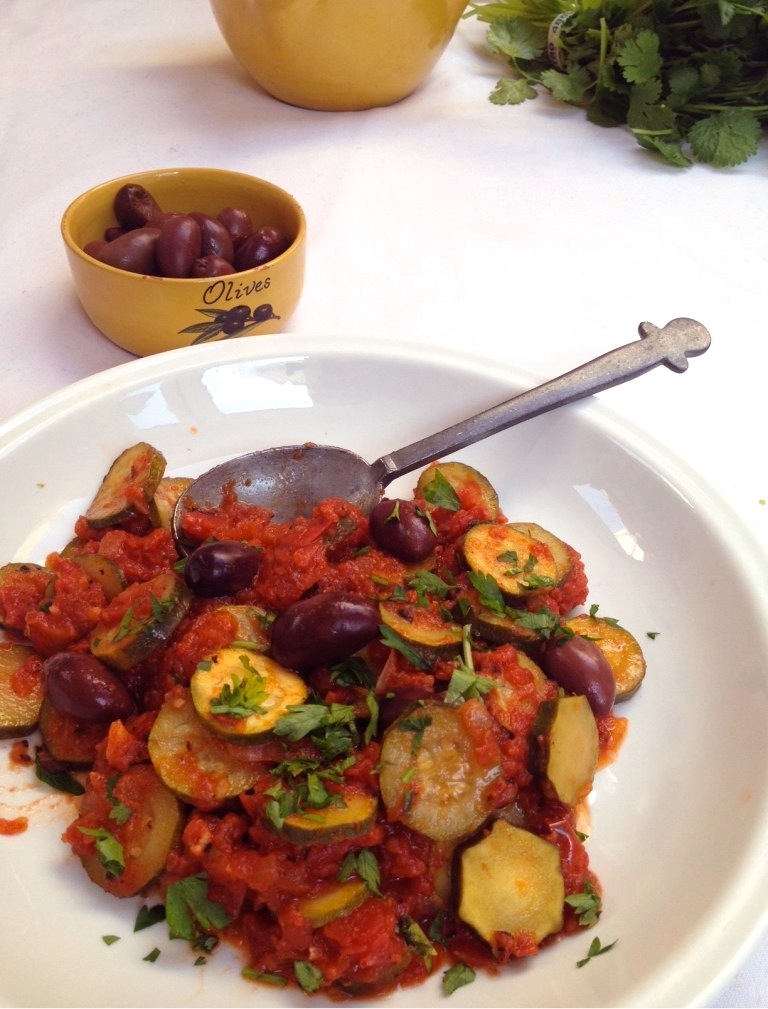
Zucchini, Tomatoes, and Black Olives

I started making this years ago as a “low cal” dish during one of my periodic dieting binges.  It is really versatile: You can make it with green and/or yellow zucchini (the smaller, the better), leave out the olives or add feta cheese. For a great pasta sauce just add a tablespoon of pesto.  I usually make it adding the zucchini directly to the tomato sauce.  However, if you sauté them first in a little oil until they brown lightly, it about halves the cooking time. Either way, it’s a delicious – and healthy – dish.

Serves 4

Ingredients

1 tablespoon olive oil

1 small onion, finely chopped

1 garlic clove

1 28-oz. can diced tomatoes (or 6 skinned and chopped tomatoes)

1 tablespoon chopped parsley or basil

4-6 zucchini, depending on size

12 black olives, pitted and halved

Slice the zucchini into thin (1/4″) rounds, salt lightly and let drain in a colander while you make a simple tomato sauce: Sauté the onion in the olive oil until softened, about 5 minutes.  Add the garlic, well-diced tomatoes, salt and pepper and cook for a few minutes to combine. Pat the zucchini dry with paper towels and add to the tomato sauce.  Cook until they are still a bit bitey – this will take about 20 minutes.  Garnish with parsley or basil and the olives.  

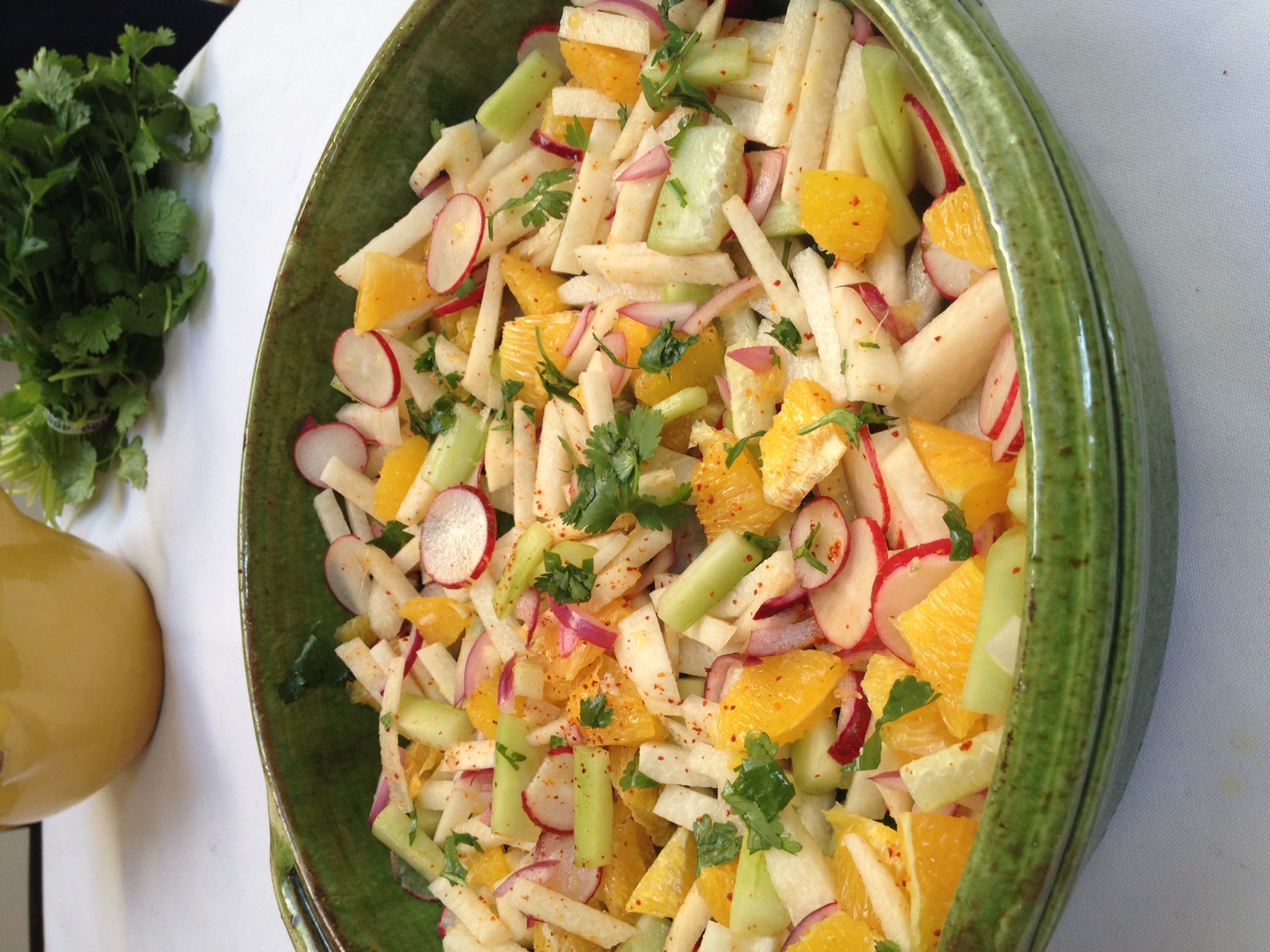
Jicama, Orange, Cucumber, and Radish Salad

This is adapted from Rick Bayless’s Mexican Kitchen.  It’s so good that you won’t be able to stop eating it.  Zero calories. Does this sound like a commercial?   Make it and it’ll soon become a favorite.

Serves 4 

Ingredients

1 medium jícama

1 cucumber

2 seedless oranges

6 radishes

1/3 cup lime juice

1 teaspoon chili powder

1 tablespoon chopped cilantro

Peel the jícama, cut it into 1/4-inch slices and then into batons about 1″ x 1/4″.  Salt, and toss with half the lime juice and half the chili powder. Let it marinate while you prepare the rest of the ingredients. Peel the cucumber, cut it in half and scoop out the seeds if they’re well formed. Slice into half-moons,1/4 inch thick. Peel the orange and cut it into small segments, removing all the pith. Slice the radishes thinly. The aim of all this slicing and dicing is to make each bite fill your mouth with a balance of flavors so that none dominates.

Mix these ingredients together, adding the rest of the lime juice and the chili powder and more salt  to taste.  Sprinkle with the chopped cilantro and serve immediately. But don’t worry if the dish stands a while – the ingredients will weep a little making an even richer sauce.

In the holiday season it’s easy to be overwhelmed by rich desserts.  We always make a Christmas trifle, but other than that we prefer our sweet calories in the form of berries or seasonal fruit such as pears, persimmons or tangerines.  Which doesn’t mean there isn’t room for an occasional tart or two.

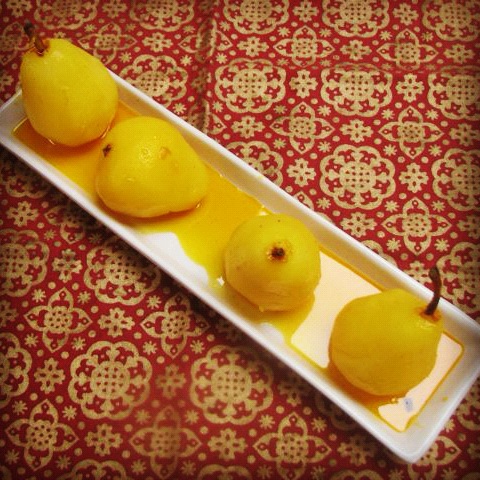
Poached pears are so common that it’s almost superfluous to give a recipe for them.  They can be poached – whole, halved or sliced – in white or red wine, in simple syrup, or any other creative liquid of your choosing. As well as adding all manner of  spices and herbs, you can top them with chocolate (the French then call it Poire Belle Hélène) or a myriad of ice creams or sorbets or the liqueur Poire William.  So what does this recipe have to offer?  Well, it’s our favorite way to poach pears and we took these really neat pictures that it seemed a pity to waste.  I added a small pinch of saffron to the poaching liquid, mainly to give them their golden glow. It gives their flavor a slightly mysterious note.

Poached Pears

Serves 4

Ingredients

4 firm (not too ripe) pears –

2 cups full-bodied white wine (chardonnay, viognier)

1/2 cup vanilla sugar  (or 1/2 cup sugar and a stick of vanilla)

1 cinnamon stick

Water (enough to cover the pears)

Peel the pears, retaining the stem. (If you’re not going to cook them immediately, put them in acidulated water.) Put them in a pot, small enough to just hold them upright. Add the wine, sugar, cinnamon stick and enough water to just cover them.  Poach until they pierce easily with a fork (10-15 minutes).  Remove the pears and reduce the liquid until you have about half a cup, enough to glaze the pears.  Serve as is, or with whipped cream or ice cream.

Pears also have a wonderful affinity for blue cheese.  There is an old – and often quoted – Tuscan expression that says that a peasant will never tell you how well pears go with cheese.  My husband finds this utterly charming, but the meaning has always baffled me. I suppose centuries ago it meant that the wily peasant could keep this delicious secret  from the rich landowner.

A restaurant near where we live in the south of France makes a beautiful tart whose sliced pears radiate from the center alternating with slices of an ancient blue cheese, Forme d’Ambert.  When it bakes, the cheese melts and flows around the pears and the resulting combination of crisp pastry, juicy pears and melting cheese is quite sublime.  I make it using whatever good blue cheese is available.

I have to admit that baking is not my strong suit (Sam, on the other hand, loves to bake.)  It’s not that I’m too lazy to make pastry–I do make it, but I’m just not very good at it.  So I tend to buy pastry shells or frozen puff pastry, especially in France where the variety and quality is excellent.

Pear and Blue Cheese Tart

Serves 4 – 6

Ingredients

1  9″ pie shell

2-3 ripe pears

4 oz. blue cheese (Stilton, gorgonzola, roquefort or a good domestic blue)

Heat the oven to 350 degrees. Pre-bake the pie shell until it’s beginning to brown around the edges (about 15 minutes.)  Let cool.  In the meantime, peel the pears and slice them lengthwise into thirds, removing the cores.  Slice each third crosswise, into thin slices, keeping the whole together.  Place each section in the pie shell, fanning them out a bit.  This sounds complicated but as the picture shows, it’s really quite simple.  Slice the cheese into thin slices and tuck them between the pears, saving a few pieces to scatter on top.  Bake until the crust is golden, the pears are cooked through and the cheese has melted.  Serve immediately.

As for the walnut pie, we were given about a bushel of wonderful fresh walnuts in the fall.  We have cracked them and eaten them, put them in salads, made pesto, and finally run out of ideas.  Until we thought why not substitute them for pecans in a pie?  The recipe is pretty standard for a pecan pie, and the walnut version is a not-so-sweet and pleasant change.

Walnut Pie

Serves 6-8

Ingredients

1 cup light corn syrup

3 eggs, lightly beaten

3/4 cup sugar

1/3 cup melted butter

1 teaspoon vanilla

1-1/2 cups walnuts, coarsely chopped

1 9″ pie shell

Preheat oven to 350 degrees.  In a large bowl, mix first five ingredients until well blended. Stir in the walnuts. Pour into unbaked pie shell. Bake for about 45 minutes. When a toothpick inserted in the center comes out clean, the pie is done.  Cool and enjoy!

There are many kinds of fish tacos — good, bad, mediocre.  You can just grill or fry a piece of fish, use some bottled salsa, slice up some avocado, warm up a tortilla or two and be perfectly satisfied.  But a REALLY good fish taco is to die for and I think it’s worth the extra effort to come up with the best.  After a lot of trial and error, I’ve settled on two favorites, either of which I would consider having at my Last Supper.

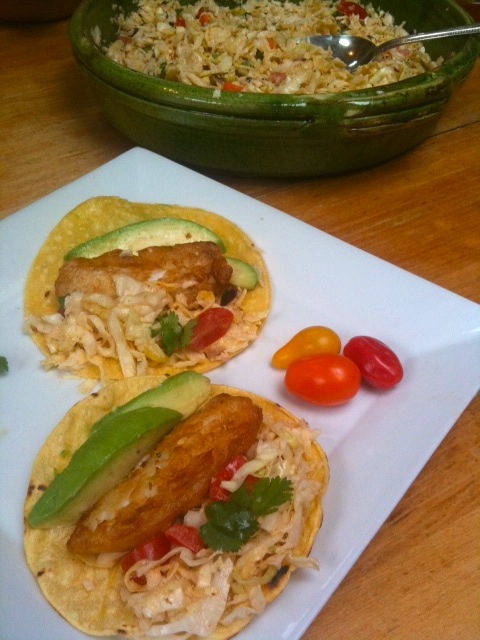
The first is Baja-style: I use a firm-fleshed white fish such as cod, batter-fry it to a crisp, then put it in a warm tortilla along with sliced avocado and a wonderful fresh slaw. That’s it.

What’s so great about that, you ask?  Follow the recipe carefully and you’ll find out.

Baja-style Fish Tacos

Serves 4  (2 tacos per person)

For the batter:

1/2 cup all-purpose flour

Pinch of salt

1 tablespoon olive oil

1/2 cup tepid water

1 egg white

Sieve the flour with the salt, blend in the olive oil and then the water.  Stir to a smooth cream, then let sit for at least an hour, preferably two. Before using, fold in the stiffly whipped egg white.

For the Mexican slaw:

6 cups thinly-sliced cabbage

1 large garlic clove 

1 teaspoon cumin seeds (or 1/2 teaspoon ground)

1 teaspoon salt

1/2 cup mayonnaise

1 tablespoon vegetable oil

1 tablespoon canned chipotle in adobo, chopped  

1 teaspoon lime juice

1/2 small red onion, chopped fine

6 cherry tomatoes, halved

2 tablespoons chopped cilantro

Pound the garlic clove, cumin and salt together in a pestle and mortar (or bowl).  Add all the following ingredients and mix well.  Blend into the cabbage and let it sit for at least half an hour. This will make too much slaw for the tacos but it is so addictive that you won’t have any trouble polishing it off.

For assembling (making) the taco:

1 lb. fresh cod (or other firm-fleshed white fish)

8 – 8″ corn tortillas (size is important)

1 ripe avocado

Vegetable oil

Cut the washed and dried cod into 1/2″ x approx. 3″ pieces.  Coat the pieces well with the batter.

Heat enough oil to make 1/2″ deep in an approx. 9″ non-stick pan until a drop of batter immediately crisps.  Fry the fish on each side 2-3 minutes until golden.  Drain on paper towels.

In the meantime, wrap the tortillas in foil and heat in the oven or wrap them in a dampened paper towel and heat in a microwave.

Peel and cut the avocado into 16 slices (2 per taco).

Assemble the tacos: cup each tortilla in your hand and put in two or three pieces of the fish.  Load up with the slaw and a few slices of avocado. Devour immediately.

Salmon, Black Bean, Goat Cheese and Tomatillo-Guacamole Burritos

Serves 4 

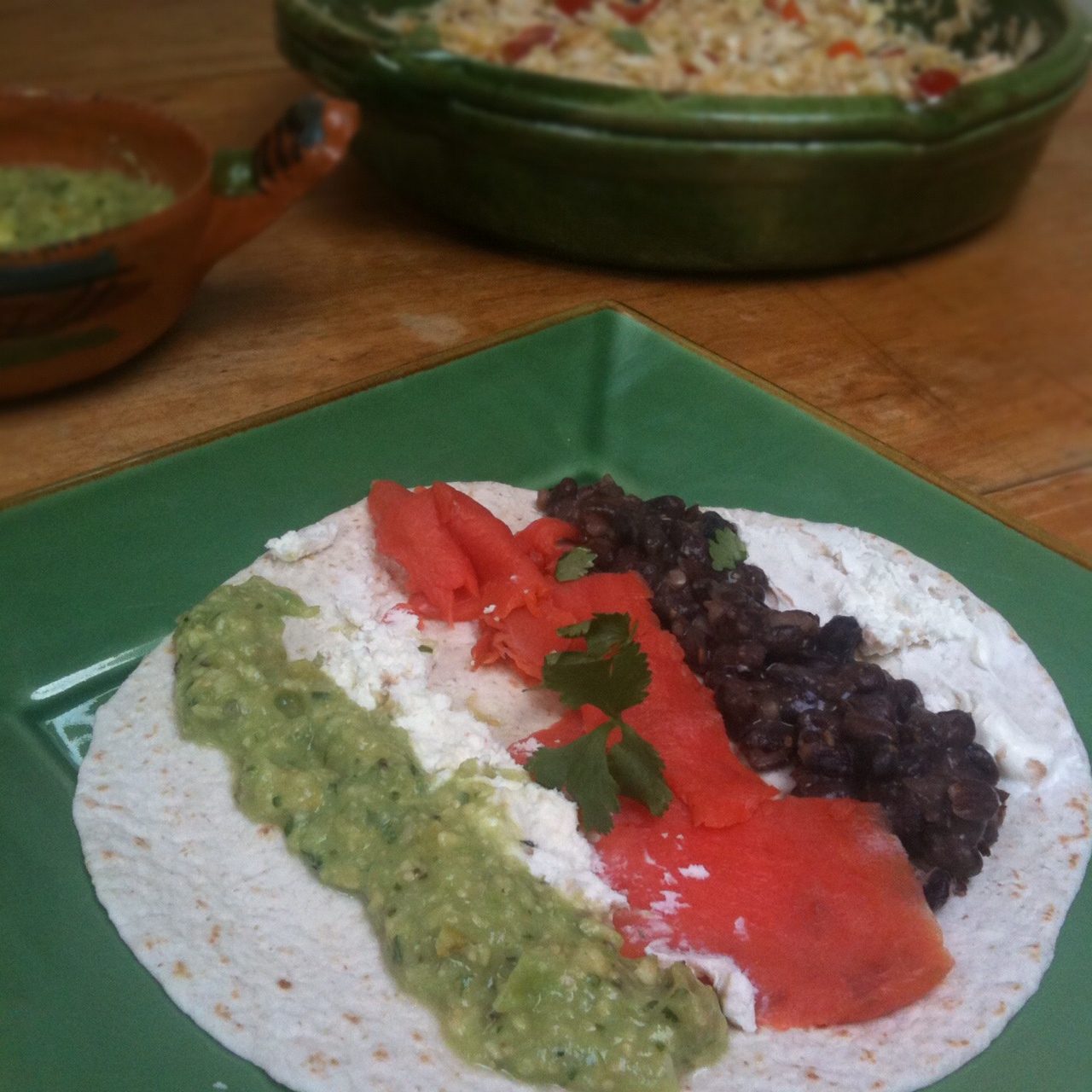
This involves flour tortillas, so it’s technically more of a burrito than a taco. These ingedients make for a kaleidoscope of colors and flavors. I like it best with grilled salmon, but I’ve also made it with store-bought smoked salmon and liked it just fine.

Ingredients:

6 tomatillos

1  ripe avocado

1 clove garlic

1 jalapeño pepper

1tablespoon chopped cilantro

Salt

1 15 oz. can black beans

1/2 teaspoon cumin

1 teaspoon lime juice

12 oz. salmon filet (or 2×6 oz.)

1 teaspoon olive oil 

4 – 8-10″ flour tortillas

4 oz. fresh goat cheese

For the Tomatillo-Guacamole:

Remove the husks from the tomatillos and rinse them under warm water to remove their stickiness.  Place them, along with the clove of garlic, in a skillet on a medium flame. Turn them a few times until blackened in spots and slightly softened, about 10 minutes.  Peel and chop the garlic and put it in a food processor along with the halved tomatillos, chopped jalapeño, avocado, cilantro and salt.  Puree on pulse until almost smooth, but with some texture remaining.  Transfer mixture to a bowl.

For the Black Beans:

Heat  the beans in a saucepan with about half of their liquid and the cumin, mashing them slightly.  Add salt and the lime juice.

For the Salmon:

Paint the filets with the olive oil, salt and pepper.  Broil or cook on a grill pan for 3-4 minutes a side, depending on the thickness of the filets, until still opaque in the center.

Assemble the burritos:

Wrap the tortillas in foil or paper towels, heating them in the oven/microwave.  Spread each one with 1/4 of the goat cheese, 1/4 of the salmon, placed across the center of the tortilla. Add a spoonful or two of black beans on one side and the same of the guacamole on the other.  Roll up and serve. (If you like your tortillas piping hot as I do, you can give them a minute in the microwave.) 

While asparagus at the height of its season is probably best with little more than melted butter or olive oil and lemon, those imported at other times from southern climes shouldn’t be totally ignored. I know this would probably be rejected by hardline locavores, but if you love asparagus as much as we do, there are many tempting dishes that can alleviate your asparagus craving in the winter.

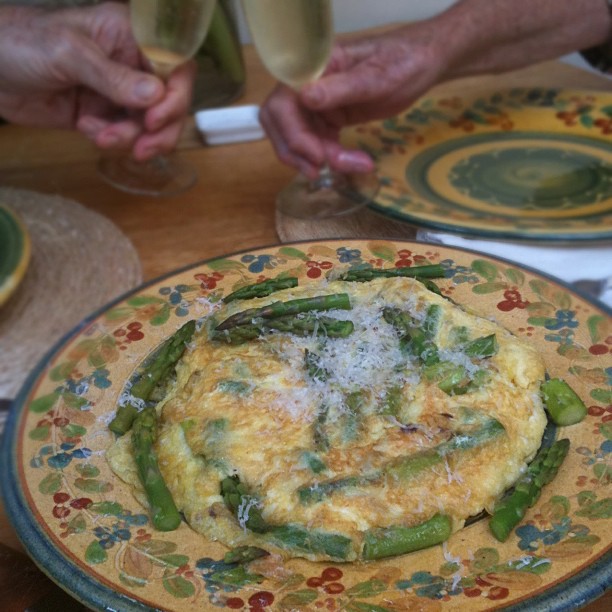
Eggs and asparagus have a natural affinity. They are wonderful companions whether the eggs are boiled, fried, poached, scrambled, or made into an omelette or quiche.

Our favorite is an Italian frittata. There’s not a significant difference between a frittata and a Spanish tortilla, and once you’ve mastered the technique, the sky’s the limit in the variety of ingredients you can use. In addition to the classic potato tortilla, we especially love the combination of onion, shrimp and spinach and the French omelette paysanne which includes onion, bacon or ham, mushrooms, potato and red peppers.

Asparagus Frittata

Serves 4

2-1/2 tablespoons olive oil

1 small onion, sliced thin

12 fat asparagus, tough ends removed

8 large eggs, lightly beaten

1/2 cup parmesan, grated

Saute the onion in 1 tablespoon of the oil in a 10″ non-stick skillet over low heat until softened.  Meanwhile, steam the asparagus until they pierce easily with a knife, depending on size, 5 – 8 minutes. Cut each asparagus spear into 3-4 pieces, add them , the onions and half the parmesan to the beaten eggs and salt and pepper to taste. 

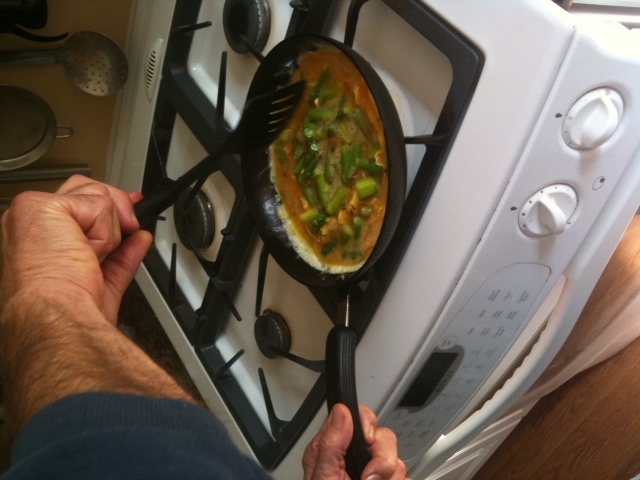
Add a second tablespoon of oil to the pan and increase the  heat until the pan is very hot. Add the egg mixture, distributing the asparagus and onion evenly. It will immediately begin to bubble and solidify around the edges.  With a spatula, and working as quickly as you can, start pulling the cooked egg into the center of the pan, releasing the rest to the outside.  If your pan is hot enough and you work quickly, you should have a fairly solid (but not dry) mass within a minute or two. Now comes the tricky part: You need to place a plate slightly larger than the skillet on top of it and invert the frittata onto it.  It may be a bit tricky the first time but you’ll soon get the hang of it.

Now add another half tablespoon of oil to the pan, let it heat briefly, and slide the frittata back into the pan, uncooked side down.

Give it a minute or so (no more) and it’ll be cooked. Many instructions for frittatas and tortillas advise cooking it for several minutes on each side or putting it under the broiler instead of inverting it.  This makes for one tough frittata.  Slide or flip it back onto the (cleaned) plate. Shower with the rest parmesan and serve immediately.

When to have this? It’s great for lunch or a light supper with a green salad,  and wonderful picnic fare, cut into cake-style slices and served at room temperature.

Sam says:

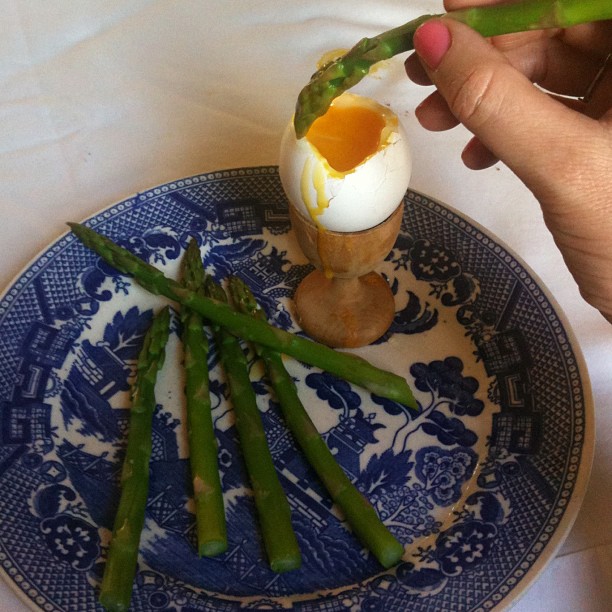
When I was a little girl, my mom used to make us soft-boiled eggs with soldiers whenever we were in need of comfort food, long before the term “comfort food” existed. Soldiers are essentially buttered toast cut into strips, making them ideal for dunking. I loved placing my egg in my little chicken egg cup (which I still have!), tapping off the “lid” of it, and dipping each soldier in slowly to soak up the golden nectar inside.

I still love soft-boiled eggs, though nowadays I prefer using asparagus as the “soldier” or peeling them entirely and placing them atop a hearty salad of greens with bacon and potatoes.

To make the perfect soft-boiled egg, I place an egg in a pot of boiling water, leave it for five minutes, and then drain and run it briefly under cold water.  When it’s cool enough to peel, I do so. Delicious!